

List every air tool that runs at the same time and note how much air (CFM) each one uses at its working pressure. Add them up, allow for how often each one actually runs, then add about 25 percent headroom. Choose a compressor whose free air delivery (FAD) at your working pressure meets that figure, with a tank big enough to smooth out peaks.
In this guide 13 sections
- The Three Numbers That Matter
- Step 1: List Your Tools and Their Air Use
- Step 2: Allow for How Often Each Tool Runs
- Step 3: Add Headroom
- A Worked Example
- Step 4: Choose the Tank
- Step 5: Single Stage or Two Stage?
- Installation: Get These Right on Day One
- Water in the Air: Plan for It
- Maintenance Checklist
- Compressors in a Complete Workshop
- How We Help
- FAQs
Most workshop compressors are bought by horsepower. "Give me a 5 HP." It is the wrong starting point, and it is why so many shops end up with a compressor that runs all day and still can't keep the spray gun happy, or one that is twice as big as it needs to be.
Your air tools don't care about horsepower. They care about air flow (CFM, or litres per minute) at the pressure they need. Get those two numbers right, and the horsepower, the tank and the type of compressor follow naturally.
This guide walks you through sizing a compressor the way we do it with customers: list the tools, add up the air, add a margin, then pick the machine. We also cover tanks, single vs two stage, installation and the maintenance that keeps a compressor alive.
The Three Numbers That Matter
1. Air flow: CFM or litres per minute
How much air the compressor actually delivers. In India you will see it as CFM (cubic feet per minute) or LPM (litres per minute). One CFM is about 28.3 litres per minute.
Ask for the free air delivery (FAD), the air actually delivered at a stated pressure. Some brochures quote "piston displacement", which is the theoretical volume the pistons sweep. Real delivery is always lower. Comparing one supplier's displacement with another's FAD is comparing apples and mangoes.
2. Pressure: bar or PSI
How hard the air pushes. Most pneumatic tools are rated for about 6 to 7 bar (90 to 100 PSI) at the tool. The compressor must deliver a little more than that to cover pressure drop in the pipes, hoses, filters and fittings.
3. Horsepower
The motor size. HP tells you roughly how much air a compressor can make, but two compressors with the same HP can deliver quite different FAD depending on the pump design and the pressure. Use HP as a rough guide, not a specification.
Step 1: List Your Tools and Their Air Use
Check each tool's nameplate or manual for its air consumption. Here are typical figures to start with:
| Tool | Typical air use (CFM at about 6 bar) | How it is usually used |
|---|---|---|
| Blow gun | 2 to 4 | Short bursts |
| Tyre inflator | 1 to 2 | Short bursts |
| Air drill | 3 to 6 | Intermittent |
| Air ratchet | 3 to 5 | Intermittent |
| 1/2" impact wrench | 4 to 6 | Intermittent |
| Air angle grinder | 5 to 8 | Long runs |
| Spray gun (conventional) | 6 to 10 | Continuous while painting |
| Spray gun (HVLP) | 8 to 12 | Continuous while painting |
| Small sandblaster | 10 to 25 or more | Continuous, depends on nozzle |
| CNC air blow-off | Varies by nozzle | Frequent short bursts |
Swipe the table sideways to see every column →
These are typical values only. Your tools' own figures always come first.
Step 2: Allow for How Often Each Tool Runs
A blow gun used for a few seconds every few minutes doesn't need its full rating supplied all the time. A spray gun in use does. Multiply each tool's CFM by the share of time it actually runs:
- Continuous tools (spray guns, sandblasters, grinders in long use): 100 percent
- Frequent intermittent tools: about 50 percent
- Occasional tools (blow guns, inflators, impact wrenches in light use): about 25 percent
Step 3: Add Headroom
Add about 25 percent on top. That covers leaks (every workshop has some), pressure drop, tools wearing and drawing more air, and the extra tool you will buy next year.
A Worked Example
A small fabrication and painting shop runs, at the same time:
| Tool | CFM | Share of time | Average CFM |
|---|---|---|---|
| HVLP spray gun | 10 | 100% | 10.0 |
| 1/2" impact wrench | 5 | 25% | 1.25 |
| Blow gun | 3 | 25% | 0.75 |
| Total | 12.0 | ||
| With 25% headroom | 15.0 CFM |
Swipe the table sideways to see every column →
So this shop needs about 15 CFM of free air delivery at around 7 bar. As a very rough rule, small piston compressors deliver something like 3 to 4 CFM per HP at workshop pressures, which points to a compressor in the 5 HP class. Ask for the actual FAD figure before you decide.
Step 4: Choose the Tank
The tank stores compressed air. A bigger tank does two things: it carries you through short bursts of high demand, and it lets the compressor run longer cycles with longer rests in between, which is easier on the motor and pump.
Our range pairs each motor with a tank sized for it:
| Model | Type | Tank capacity | Tank size (dia x length) |
|---|---|---|---|
| 1 HP | Double piston | 100 litres | 15" x 32" |
| 2 HP | Double piston | 150 litres | 18" x 32" |
| 3 HP | Two stage | 160 litres | 16" x 50" |
| 5 HP | Two stage | 200 litres | 18" x 48" |
| 7.5 HP | Heavy duty | 250 litres | 18" x 58" |
| 10 HP | Heavy duty | 300 litres | 18" x 72" |
Swipe the table sideways to see every column →
Models above 10 HP, up to 50 HP, are available with specifications on request.
For spray painting, a larger tank matters more than it seems. It keeps the pressure steady through a long pass, so the finish stays even from one end of the panel to the other.
Step 5: Single Stage or Two Stage?
A single stage compressor (including our double piston models) compresses air to full pressure in one step. It is simple and affordable, and it suits lighter, intermittent use.
A two stage compressor compresses the air partly in a large cylinder, cools it, then finishes compression in a smaller cylinder. It reaches higher pressure, runs cooler and is more efficient for sustained output. That makes it better for spray painting, sandblasting and multiple tools running together.
For continuous, all-day air demand in a factory, we also supply screw compressors, which deliver a steady flow and are built for long running hours. Ask us when your demand outgrows a piston machine.
| Your use | Where to start in our range |
|---|---|
| Small repair shop, one tool at a time, intermittent | 1 HP or 2 HP double piston |
| Spray painting, 2 to 3 tools together | 3 HP or 5 HP two stage |
| Factory floor, several workstations, continuous | 7.5 HP or 10 HP heavy duty |
| Higher demand than that | Above 10 HP, up to 50 HP, on request |
| Continuous, all-day demand | A screw compressor (ask us) |
Swipe the table sideways to see every column →
Installation: Get These Right on Day One
- Ventilation. A compressor turns most of its electrical power into heat. Put it where hot air can escape, not in a closed cupboard.
- Clean, cool, dry intake. Keep the intake away from dust, grinding sparks, paint booths and heat sources. Hot, dusty intake air wears the pump and costs efficiency.
- Level, solid floor. Larger models (5 HP and up) may need anchor bolts.
- Piping. Size the main line for the full compressor output. Slope it slightly away from the compressor, take tool drops off the top of the main line, and fit a drain at the lowest point. Undersized pipes waste pressure, and pressure is money.
- Power. Check that your supply can carry the motor's starting current.
Water in the Air: Plan for It
Compressing air squeezes the moisture out of it. On a humid Ahmedabad monsoon day, even a small compressor can collect litres of water in a single shift. That water ends up in spray paint, rusts air tools and spoils pneumatic valves unless you drain it and dry the air. An air dryer is often worth adding, especially for painting; see our accessories range.
Maintenance Checklist
A piston compressor is simple to keep healthy if you do the small things regularly.
Daily
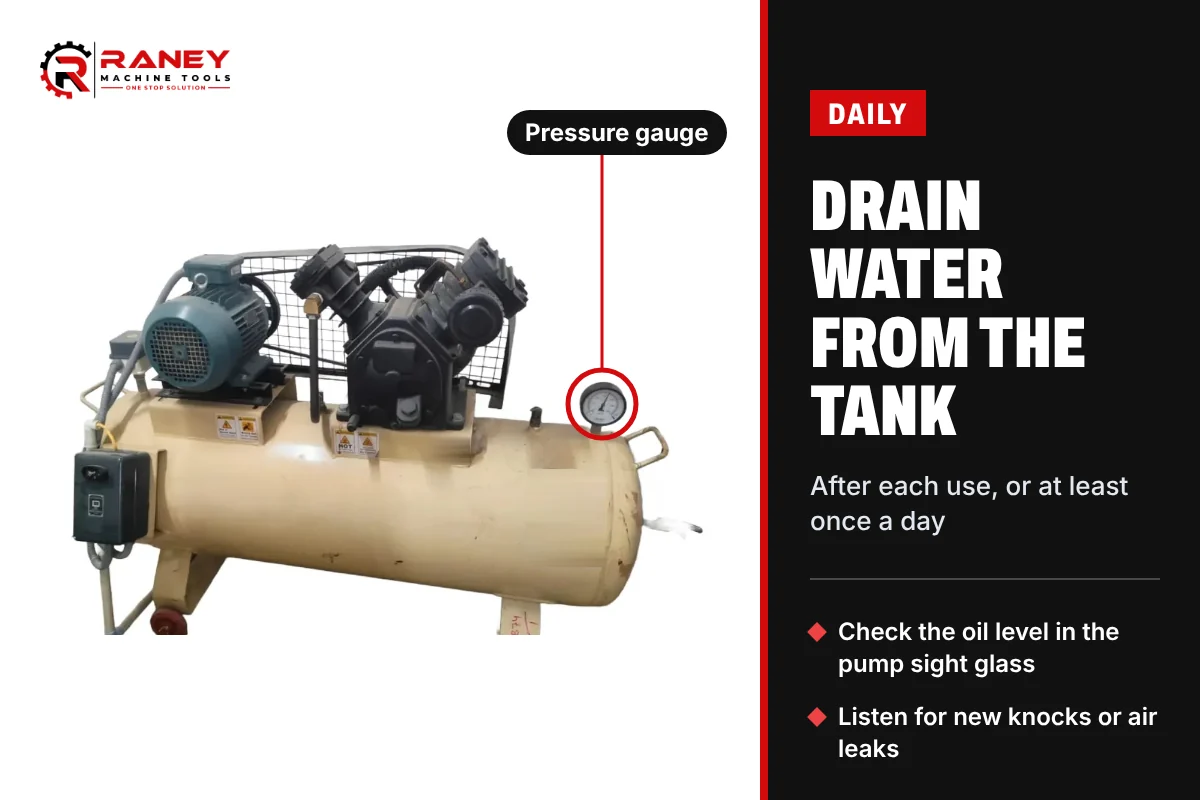
- Drain water from the tank (after each use, or at least once a day)
- Check the oil level in the pump sight glass
- Listen for new knocks or air leaks
Weekly
- Clean the intake filter (more often in dusty shops)
- Check belt tension and condition on belt driven models
- Test the safety valve by lifting its ring briefly
Monthly
- Check the pressure switch cuts in and out at the set pressures
- Look for oil leaks and loose bolts
- Check pipes and hoses for leaks with soapy water
As per the manufacturer's schedule
- Change the compressor oil
- Inspect valves and replace the intake filter element
Never adjust or block the safety valve. It is what stops the tank from being over-pressurised.
Compressors in a Complete Workshop
A compressor is usually one of the first machines a new fabrication shop buys, alongside cutting, welding and drilling. Our fabrication workshop equipment list shows where it fits in a full set-up.
How We Help
We have supplied workshop machinery across Gujarat since 1983, and we export to 5 countries: Sri Lanka, Bahrain, Oman, UAE and Saudi Arabia. As an Authorized Distributor, our compressors come with the manufacturer's warranty and genuine spares, and our team responds within 48 hours for service. We can also advise on the piping layout for your workshop.
Frequently Asked Questions
How do I choose the right air compressor size for my workshop?
Add up the air consumption (CFM) of the tools that run at the same time, allowing for how often each one runs, then add about 25 percent headroom. Choose a compressor whose free air delivery at your working pressure meets that number.
How many CFM per HP does an air compressor give?
It varies with the pump design and pressure. As a very rough rule, small piston compressors deliver around 3 to 4 CFM per HP at workshop pressures. Always ask for the free air delivery figure at your working pressure rather than relying on HP.
What size air compressor do I need for spray painting?
Most spray guns need about 6 to 12 CFM at 3 to 4 bar at the gun, continuously while painting. A two stage compressor in the 3 to 5 HP class with a 160 to 200 litre tank is a common choice for one gun. Check your gun's rating.
How big should the air compressor tank be?
Bigger tanks smooth out demand peaks and reduce how often the compressor starts and stops. Our range runs from 100 litres on the 1 HP model to 300 litres on the 10 HP. For continuous tools like spray guns, choose the larger end.
How often should I drain the compressor tank?
Daily, or after each use. In humid weather you may need to drain more often. Water left in the tank causes corrosion and sends moisture into your air lines.
Get Your Compressor Sized Properly
Send us your list of air tools, how many run at once and what you use them for. We will work out the air demand and recommend the right compressor and tank.
See every model and its tank size on our air compressors page, or compare the full range of models.

2 more guides coming in this series.