

Buy an all geared lathe if you cut hard metals, take interrupted or heavy cuts, thread often, or run production. Buy a belt driven lathe if your work is general, you change speeds rarely, and you want a simpler machine that is cheaper to buy and maintain.
In this guide 8 sections
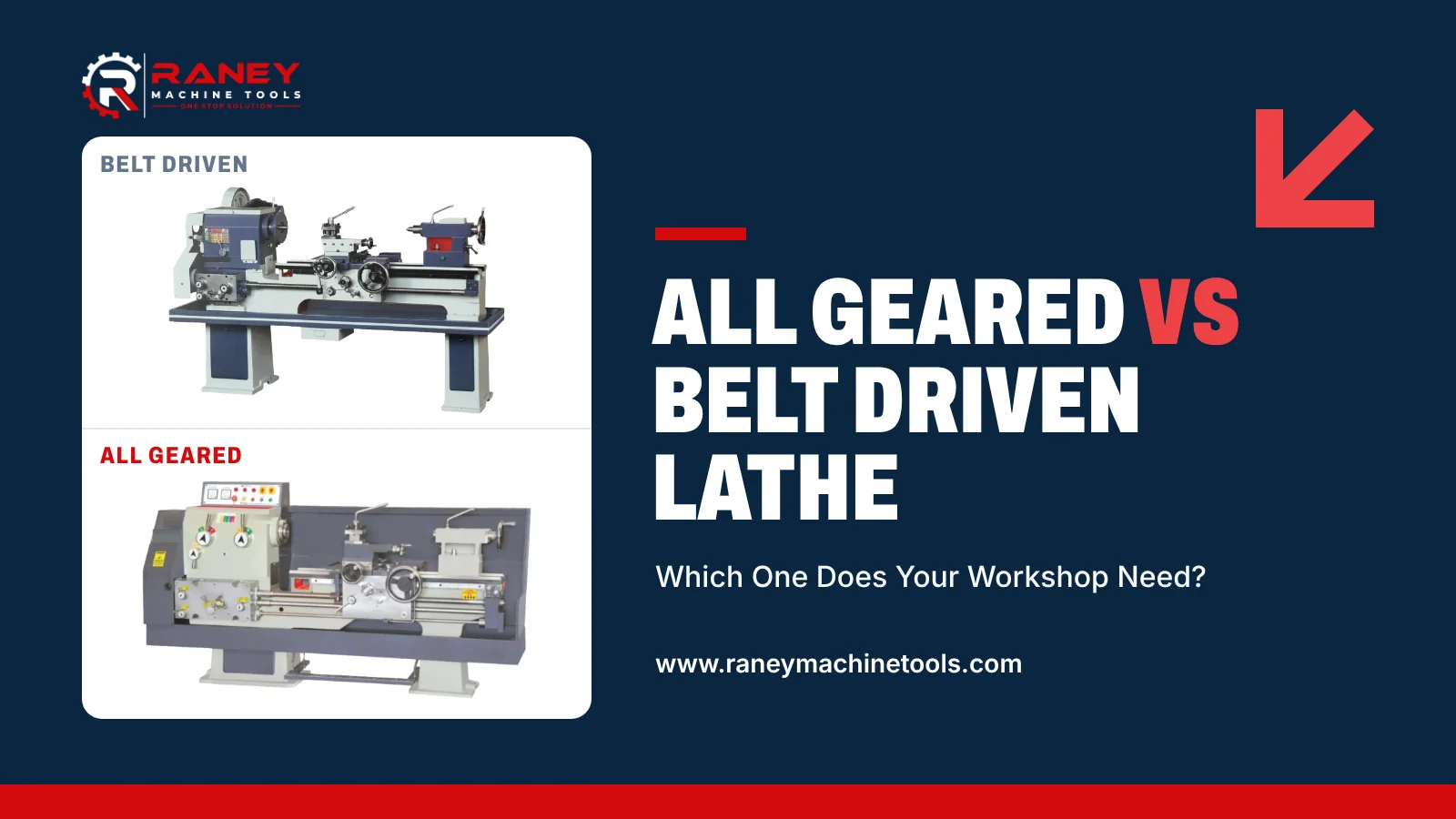
Ask ten machinists which is better, a geared lathe or a belt driven one, and you will get at least eleven opinions.
Some swear by the geared head. Pull a lever, the speed changes, and the machine never loses grip in a heavy cut. Others will tell you their old belt driven lathe gives a finer finish than any geared machine in the shop, and they are not wrong either.
The truth is that both are good machines. They are good at different things. This guide explains how each one works, where each one wins, and how to decide for your own work. If you are still at the stage of choosing the size and duty class, start with our complete lathe machine buying guide and come back here.
How a Belt Driven Lathe Works
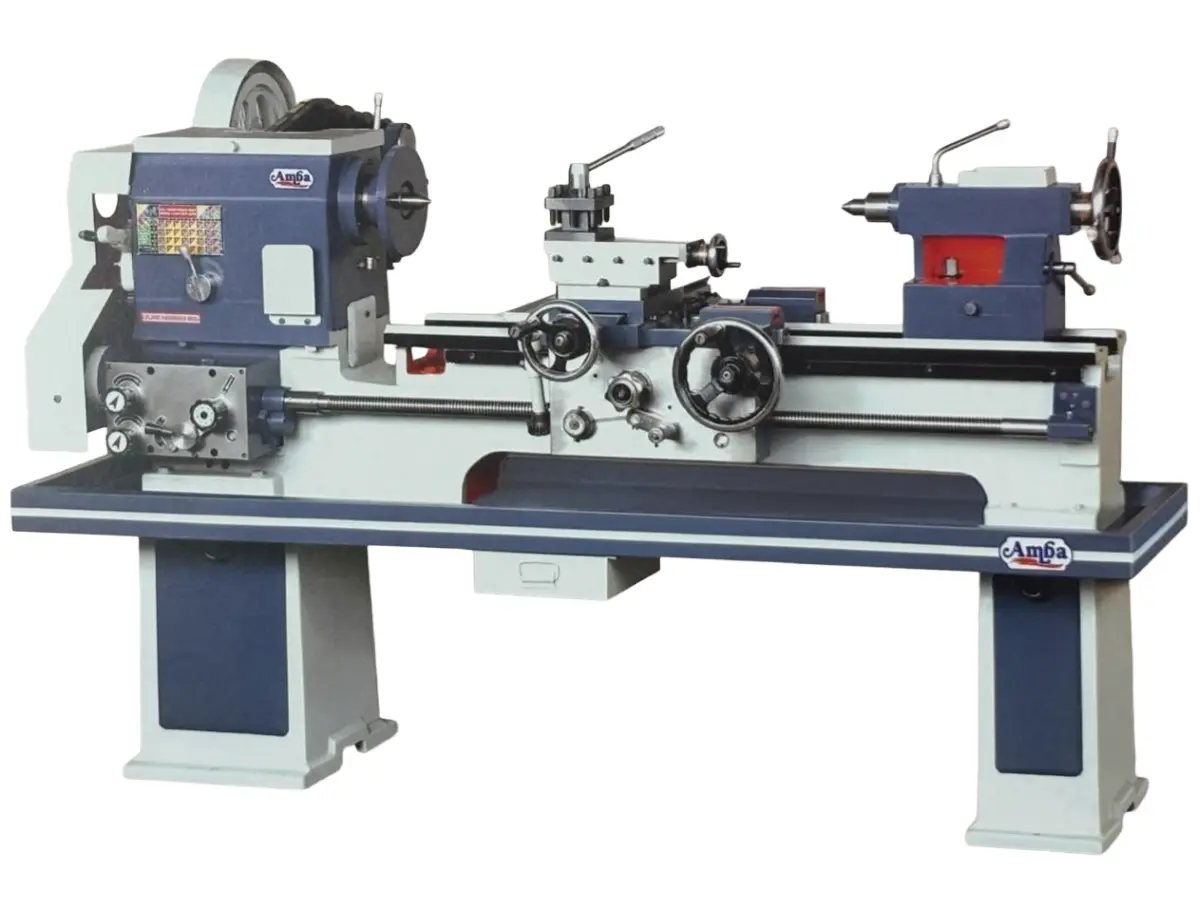
The motor drives the spindle through V-belts or a flat belt running over stepped pulleys, sometimes with a back gear for the slowest speeds. To change speed, the operator stops the machine, opens the guard and moves the belt to a different step.
That sounds old-fashioned, and in a sense it is. But the design has real strengths. A belt absorbs small shocks and vibrations before they reach the spindle. There are fewer gears to wear, fewer bearings to fail and less oil to manage. When something does go wrong, a local mechanic can usually sort it out in an afternoon.
In our range, the light, medium, heavy and extra heavy duty lathes are all belt driven:
- Light duty: 8 speeds, 25 to 730 RPM
- Medium duty: 6 speeds, 40 to 550 RPM
- Heavy and extra heavy duty: 8 speeds, 31.3 to 595 RPM
How an All Geared Lathe Works
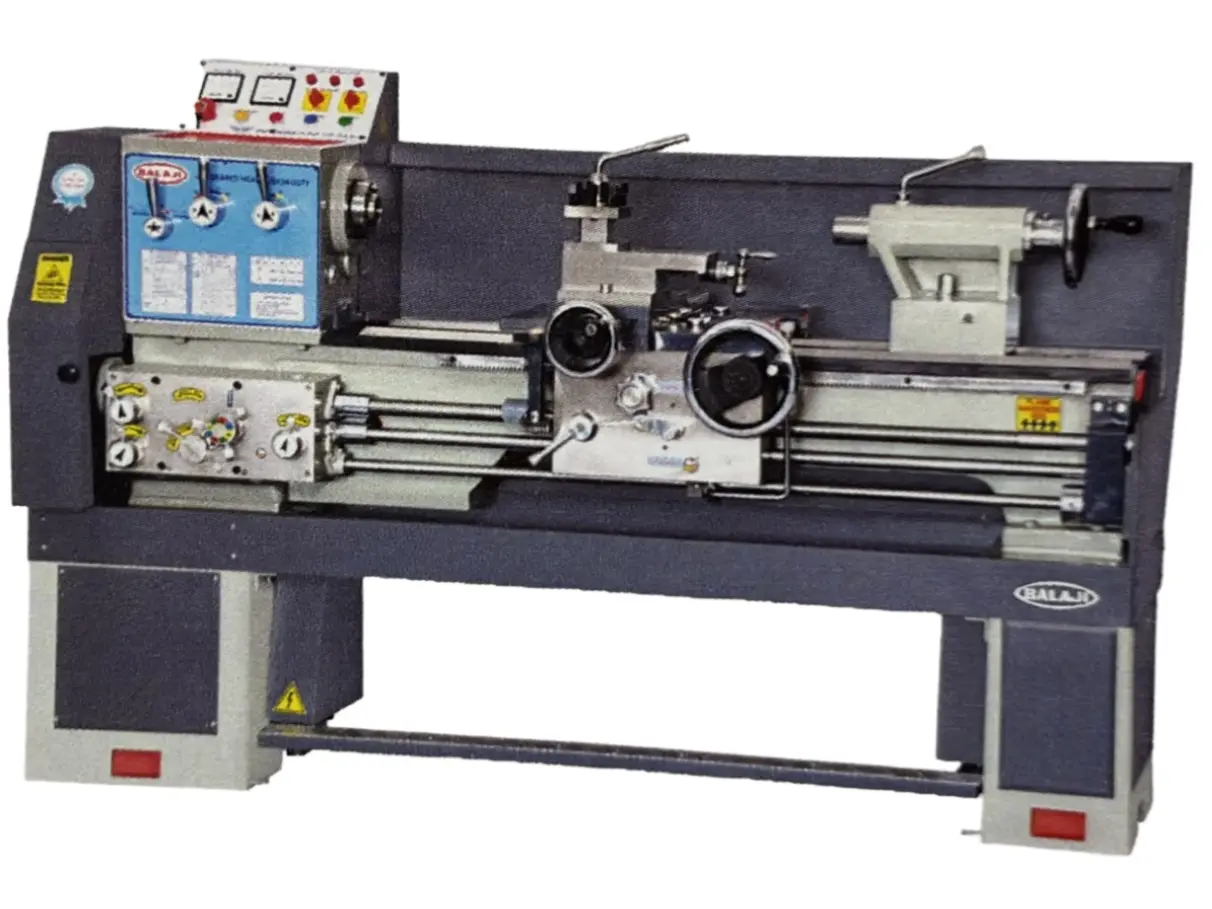
On an all geared lathe, the headstock is a gearbox. Levers on the front slide gear pairs in and out of mesh to give each spindle speed. The motor stays coupled to the spindle through gears the whole time.
Two things follow from that. First, you can change speed in seconds without opening anything. Second, the gearbox delivers the motor's full torque at every speed, including the slowest ones, where big diameters and tough cuts need it most.
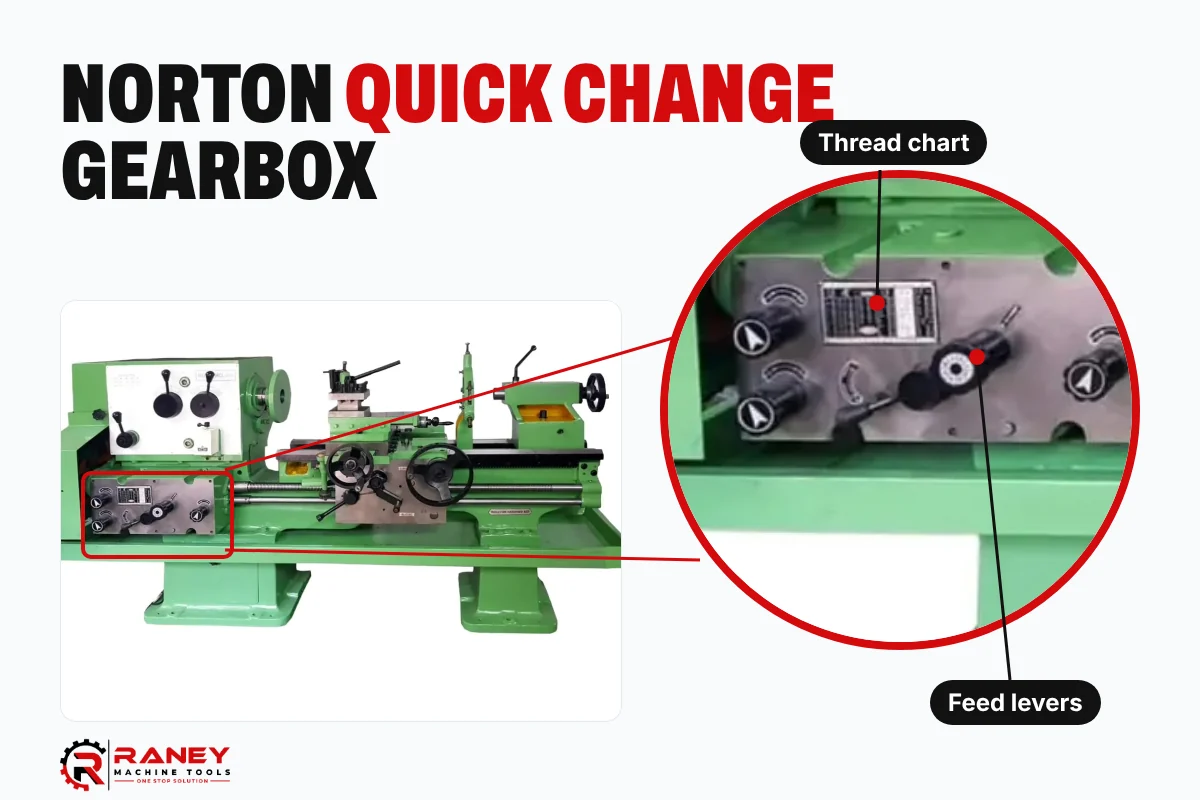
Our four geared models also carry a Norton gearbox (also called a quick change gearbox) for the feed and threading train. On a belt driven lathe, cutting a different thread pitch often means swapping change gears by hand. On a Norton gearbox you move a couple of levers. The VGM-215 and AGLM 6'3", for example, cut 24 metric threads (0.5 to 15 mm pitch) and 44 inch threads (2 to 60 TPI), with 40 feeds.
| Geared model | Speeds | Spindle bore | Swing over bed | Motor |
|---|---|---|---|---|
| VGM-215 | 8 speeds, 40 to 1200 RPM | 38 mm | 420 mm | 2 HP, 3 phase |
| AGLM 6'3" | 8 speeds, 55 to 1200 RPM | 65 mm | 495 mm | 3 HP, 3 phase |
| VGH-267 Tech Master | 12 speeds, 30 to 1060 RPM | 50 mm, or 79 / 104 mm | 525 / 600 mm | 3 / 5 HP, 3 phase |
| AGLM-304 | 12 speeds, 30 to 1060 RPM | 79 / 104 mm | 580 to 730 mm | 5 HP, 3 phase |
Swipe the table sideways to see every column →
Head to Head: Where Each One Wins
| What matters to you | Belt driven | All geared |
|---|---|---|
| Changing speed | Stop, open guard, move belt | Move a lever, a few seconds |
| Torque at low RPM | Belt can slip under a heavy cut | Full torque at every speed |
| Interrupted cuts (castings, keyed shafts) | Belt absorbs shock, but can slip | Holds speed through the knock |
| Threading many pitches | Change gears by hand on many models | Norton gearbox, quick lever changes |
| Very fine finishing cuts | Very smooth, belt damps vibration | Good, but gear mesh adds a little vibration |
| Top speed for small diameters | Up to 730 RPM in our range | Up to 1200 RPM (VGM-215, AGLM 6'3") |
| Maintenance | Belts, pulleys, simple lubrication | Gearbox oil, more bearings and gears to look after |
| Purchase price | Lower for the same size | Higher for the same size |
| Power supply | Check the motor's phase rating | 3 phase on all our geared models |
Swipe the table sideways to see every column →
Look at the pattern. A belt driven lathe wins on simplicity, cost and smoothness. A geared lathe wins on torque, speed and threading convenience.
Three Questions That Settle It
1. How often do you change speed?
If one operator turns the same kind of shaft all day, they may change speed twice in a shift. The belt is no burden.
If your shop does job work, with a pin in the morning, a flange at noon and a long shaft by evening, speed changes happen constantly. Every belt change is a few minutes of a skilled operator's time. Over a year, those minutes add up to days. This is where a geared head pays for itself.
2. What do you cut, and how hard?
Mild steel, brass and aluminium at moderate depths of cut are comfortable on a belt driven lathe. Alloy steels, castings with hard skin and interrupted cuts are a different story. At low RPM the cut needs torque, and a belt can slip just when you need grip. A slipping belt also means an uneven finish and a worn belt.
On large diameters the problem grows. A 300 mm flange in mild steel wants roughly 30 to 35 RPM with a high speed steel tool. That is the bottom of the range on our heavy duty machines and the geared VGH-267 and AGLM-304. At that speed, the geared head's direct drive is the safer bet.
3. How much threading do you do?
If you thread a few standard pitches now and then, a belt driven lathe with change gears is fine. If threading is a daily job, especially mixed metric and inch work, the Norton gearbox saves time on every changeover and removes a common source of mistakes.
The Myth That Geared Is Always "Better"
We hear it often: "Sir, give me geared. It is the better machine."
Not always. A training institute that needs a dozen lathes for students is far better off with belt driven light duty machines. They cost less, they are forgiving and they are easy to keep running. A maintenance room that turns the odd bush and pin has no need to pay for a gearbox it will rarely use.
On the other side, a production shop that buys a belt driven lathe to save money often pays the difference back in lost time within a year or two. The right answer is the one that matches your work, not the one with the bigger price tag.
Cost of Ownership, Not Just Price
When you compare the two, look past the quotation:
- Purchase price. For the same swing and bed length, the geared machine costs more.
- Running cost. Belt driven lathes need belts and occasional pulley attention. Geared heads need the right gearbox oil, changed on schedule, and more bearings and gears to look after.
- Operator time. Geared heads save minutes on every speed and thread change. In job shops, this is usually the biggest number on the page.
- Rejections. A belt slipping under load leaves marks and size errors. A geared head holds speed through the cut.
- Resale. A well-kept geared lathe from a known maker tends to hold its value in the used market.
Our Recommendation, by Type of Shop
| Your shop | Our usual suggestion |
|---|---|
| College or training centre | Light duty belt driven lathe |
| Maintenance department, occasional turning | Medium duty belt driven lathe |
| Job shop with frequent speed and thread changes | VGM-215 geared head lathe |
| Pipe and bar work through the spindle | AGLM 6'3" geared lathe, 65 mm bore |
| Heavy shafts and castings, production | VGH-267 Tech Master or AGLM-304 |
| Large rolls, simple heavy roughing on a budget | Extra heavy duty belt driven lathe |
Swipe the table sideways to see every column →
Both types are on show at our Ahmedabad showroom. Run them side by side, move the levers, change a belt and see the difference for yourself before you decide.
Frequently Asked Questions
Is an all geared lathe better than a belt driven lathe?
It is better for some jobs, not all. A geared head gives full torque at every speed, quick speed changes and easy threading, so it suits hard metals, heavy cuts and production. A belt driven lathe is simpler, smoother on light finishing cuts and cheaper to buy and run.
What is a Norton gearbox on a lathe?
It is a quick change gearbox for the feed and lead screw. Instead of swapping change gears by hand to cut a new thread pitch, you move levers to select the pitch or feed from a chart. Our geared models offer 24 metric and 44 inch threads with 40 feeds.
Does an all geared lathe need 3 phase power?
All our geared lathes run on 3 phase supply. Check your workshop's connection and connected load before ordering.
Why does a geared lathe cost more?
The headstock is a precision gearbox with hardened gears, shafts and more bearings, and most geared models also carry a Norton gearbox. That is more parts and more machining than a pulley headstock.
Can a belt driven lathe cut threads?
Yes. Belt driven lathes cut threads using the lead screw and change gears. It simply takes longer to set up a new pitch than on a geared lathe with a Norton gearbox.
Still Not Sure Which to Choose?
Tell us what you turn: the biggest diameter, the material and how often you change jobs in a day. We will suggest the right drive type and model, and send you the spec sheet.
You can also WhatsApp us on +91 70410 38728, or browse every model and its full specifications on our lathe machines page.

- Start hereLathe Machine Buying Guide: Types, Sizes and How to Choose the Right One
- GuideAll Geared vs Belt Driven Lathe: Which One Does Your Workshop Need?You are here
3 more guides coming in this series.