

Start with your largest job, not the machine. Note its biggest diameter, its longest length and the material. Add 15 to 20 percent headroom. That gives you the swing, the length between centres and the duty class. Then choose belt driven for simple, general turning or all geared for harder metals, heavy cuts and precise threading.
In this guide 12 sections
- What a Lathe Does (and Where It Stops)
- The Four Duty Classes, in Plain Words
- Belt Driven or All Geared?
- How to Read a Lathe's Size: The Numbers That Matter
- Speed and Power: A Quick Sum Worth Doing
- Match the Machine to Your Work
- Things Buyers Forget to Budget For
- What About the Price?
- New or Second-Hand?
- Your Lathe Buying Checklist
- How We Help You Choose
- FAQs
Most enquiries we get for a lathe start the same way. "I need a 6 feet lathe. What is the rate?"
It is a fair question. But it skips the one that decides everything else: what are you going to turn on it?
A lathe that suits a training institute will struggle with sugar mill shafts. A machine sized for 700 mm castings is money wasted in a shop that makes 40 mm bushes all day. Pick right, and the machine earns for twenty years or more. Pick wrong, and you live with it.
This guide walks you through the choice the way we do it across the counter. You will learn the four duty classes, what "belt driven" and "all geared" really mean, how to read a lathe's size, and how to match all of it to your actual jobs. If you already know your sizes, jump straight to our lathe machine range and its full spec tables.
What a Lathe Does (and Where It Stops)
A lathe spins the workpiece and moves a cutting tool along it or across it. That one idea covers a lot of work:
- Turning a shaft down to size, straight or tapered
- Facing the end of a job flat
- Cutting threads, metric or inch
- Boring a hole out to an exact size
- Drilling on the centre line using the tailstock
- Knurling a grip pattern and parting off finished pieces
What it won't do well is flat surfaces, slots and holes away from the centre line. Those belong to milling, shaping and drilling machines. If you are setting up a shop and wondering which machine does which job, our guide on lathe vs milling vs drilling vs grinding machines lays it out job by job.
The Four Duty Classes, in Plain Words
"Duty" is about how hard and how long the machine can cut. A heavier class means a wider and heavier bed, a bigger spindle and more motor power. It can take deeper cuts all day without chatter.
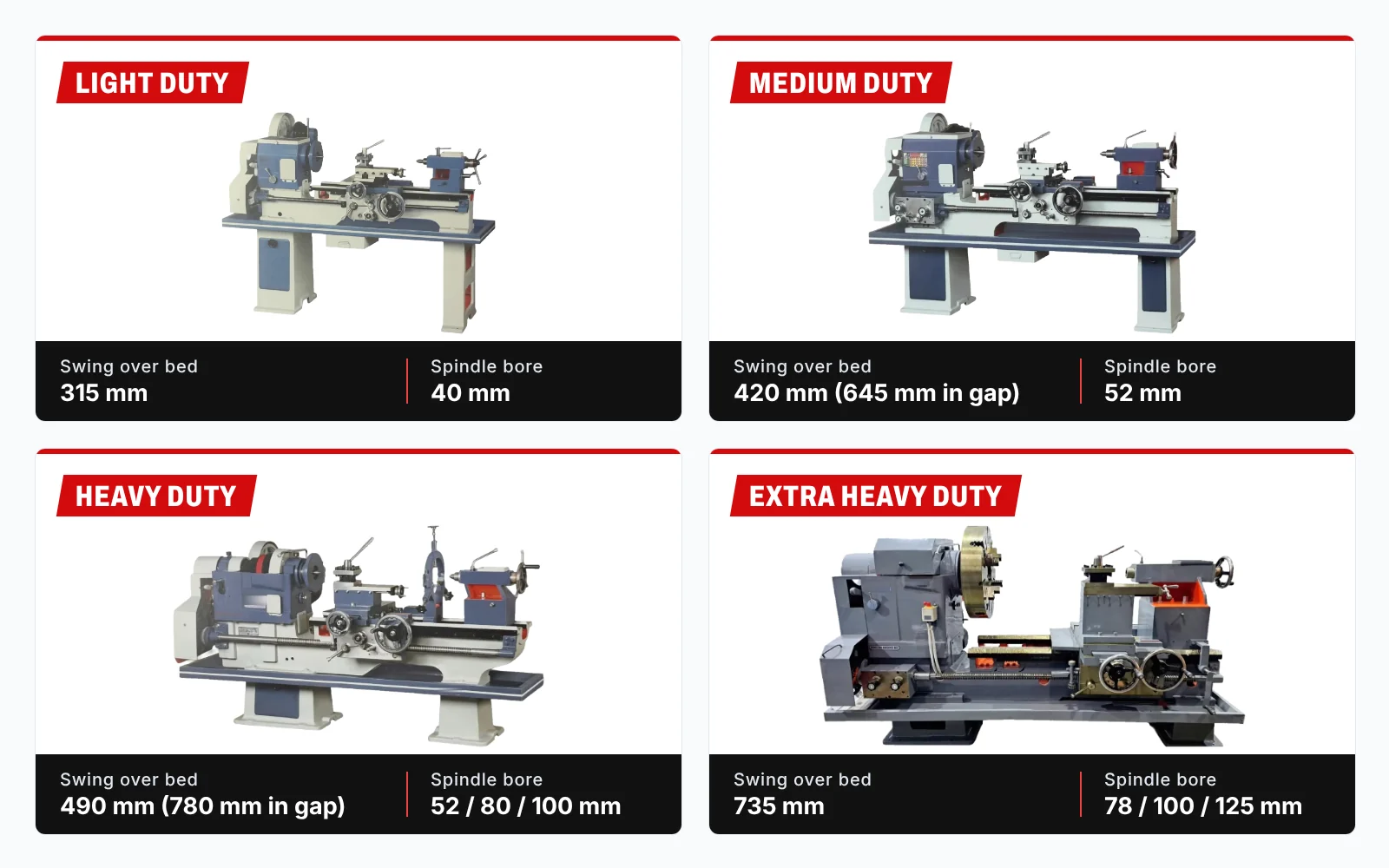
Here is how the four belt driven classes in our range compare:
| Duty class | Swing over bed | Spindle bore | Bed lengths | Motor | Typical work |
|---|---|---|---|---|---|
| Light duty | 315 mm | 40 mm | 4'6", 5'3", 6' | On request | Training centres, maintenance rooms, small parts in mild steel, brass, aluminium |
| Medium duty | 420 mm (645 mm in gap) | 52 mm | 4'6", 5'3", 6' | 2 HP | Job shops: shafts, bushes, threading in steel, cast iron, stainless |
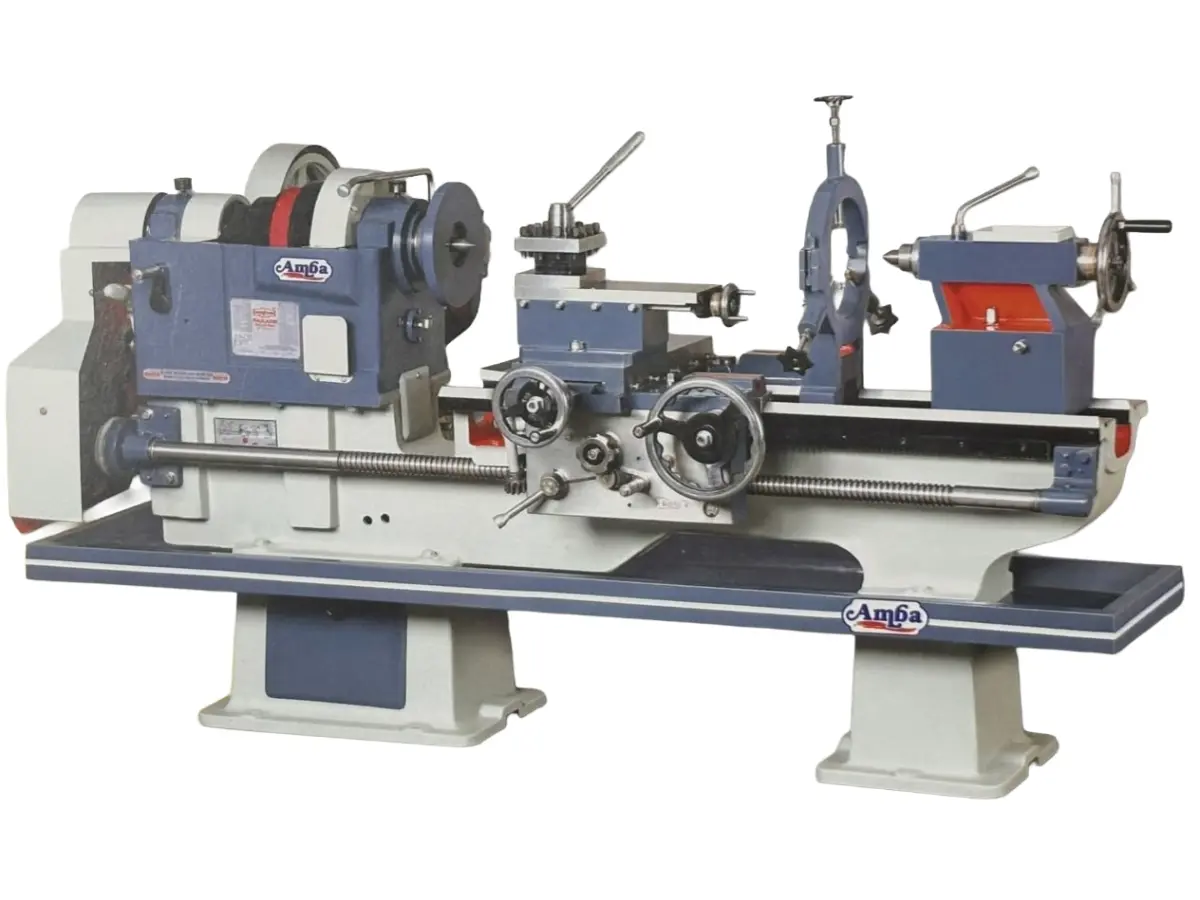
| Heavy duty | 490 mm (780 mm in gap) | 52 / 80 / 100 mm | 7 lengths, 5'6" to 16' | 3 HP | Pipe threading, forgings, castings, heavy roughing cuts |
| Extra heavy duty | 735 mm | 78 / 100 / 125 mm | 7 lengths, 5'6" to 16' | 3 HP, or 5 HP from 12' | Rolls, large shafts, cylinders for sugar, cement and steel plants |
Swipe the table sideways to see every column →
A few honest notes on this table.
Light duty is not a toy. It is the right machine for a college workshop or a maintenance room that turns small parts now and then. It is the wrong machine for daily roughing of EN8 shafts.
Medium duty is the workhorse. If you run a general job shop and most of your work fits inside 400 mm, this is where most buyers end up. It handles steel, cast iron and stainless with ease.
Heavy and extra heavy are about mass. The bed on our extra heavy duty lathe is 375 mm wide. That weight is what lets the machine take a deep cut on a big casting without shaking itself and the job loose.
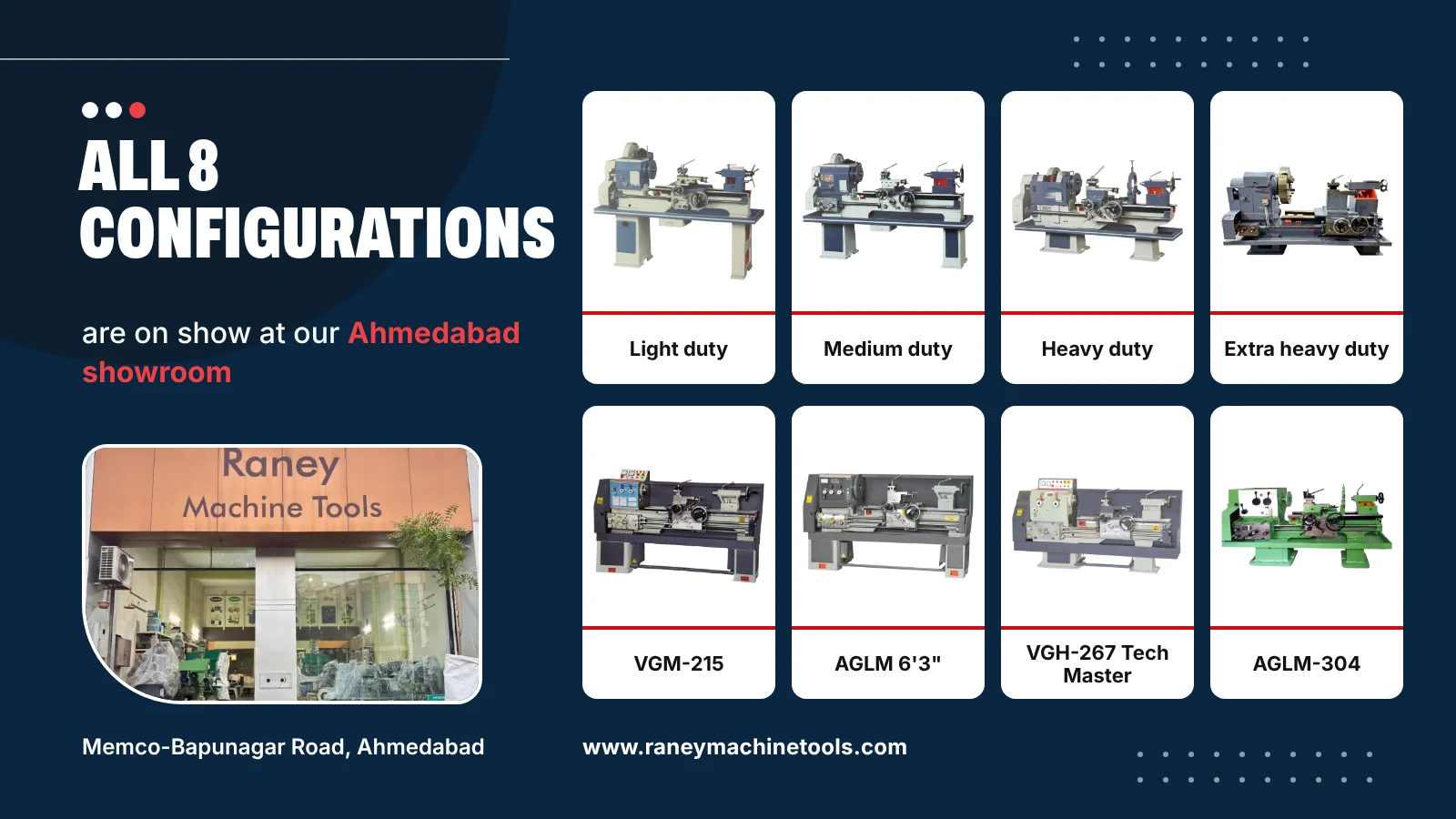
Bigger than this? These are our 8 standard configurations. We also supply larger lathes to order, with centre heights up to 1,250 mm, beds up to 50 feet and spindle bores up to 250 mm, for rolls, long shafts and heavy industrial turning.
Belt Driven or All Geared?
This is the second big decision, and people get it wrong in both directions.
On a belt driven lathe, you change speed by moving a V-belt or flat belt across stepped pulleys. It is simple, quiet and cheap to maintain. Our light, medium, heavy and extra heavy duty machines are all belt driven, with 6 or 8 speed steps.
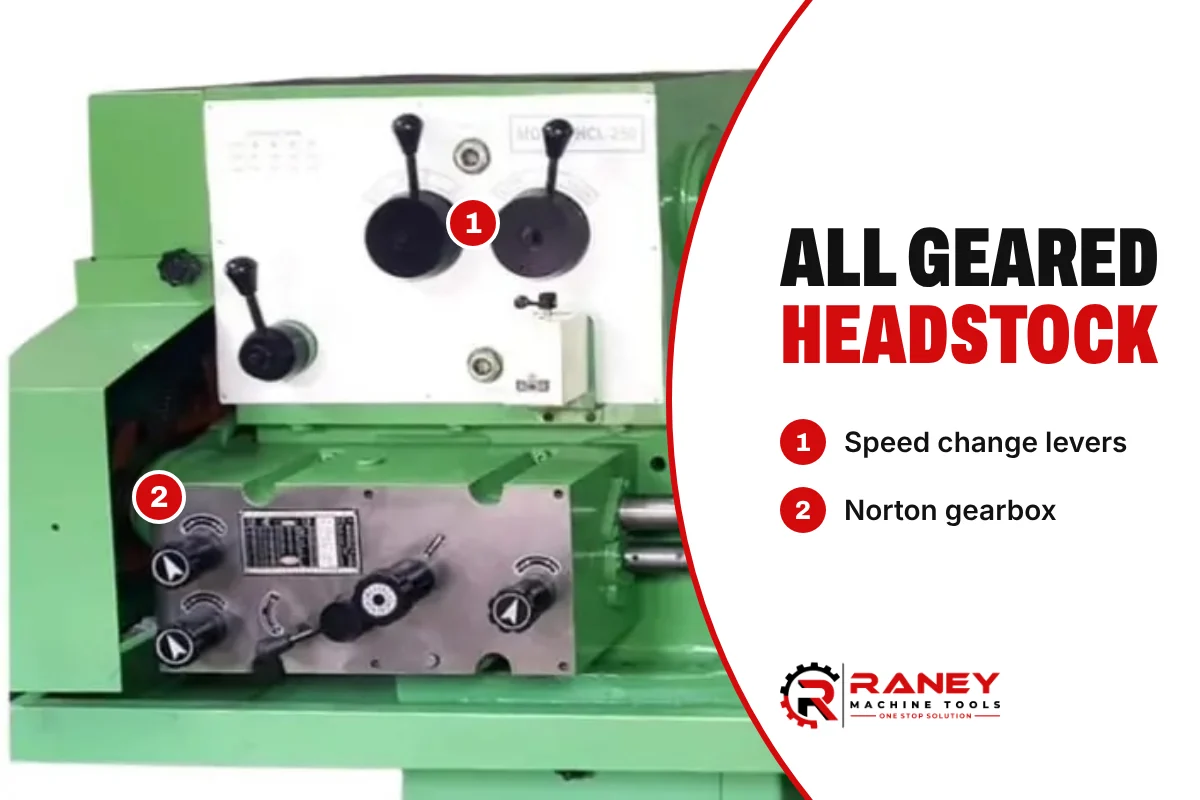
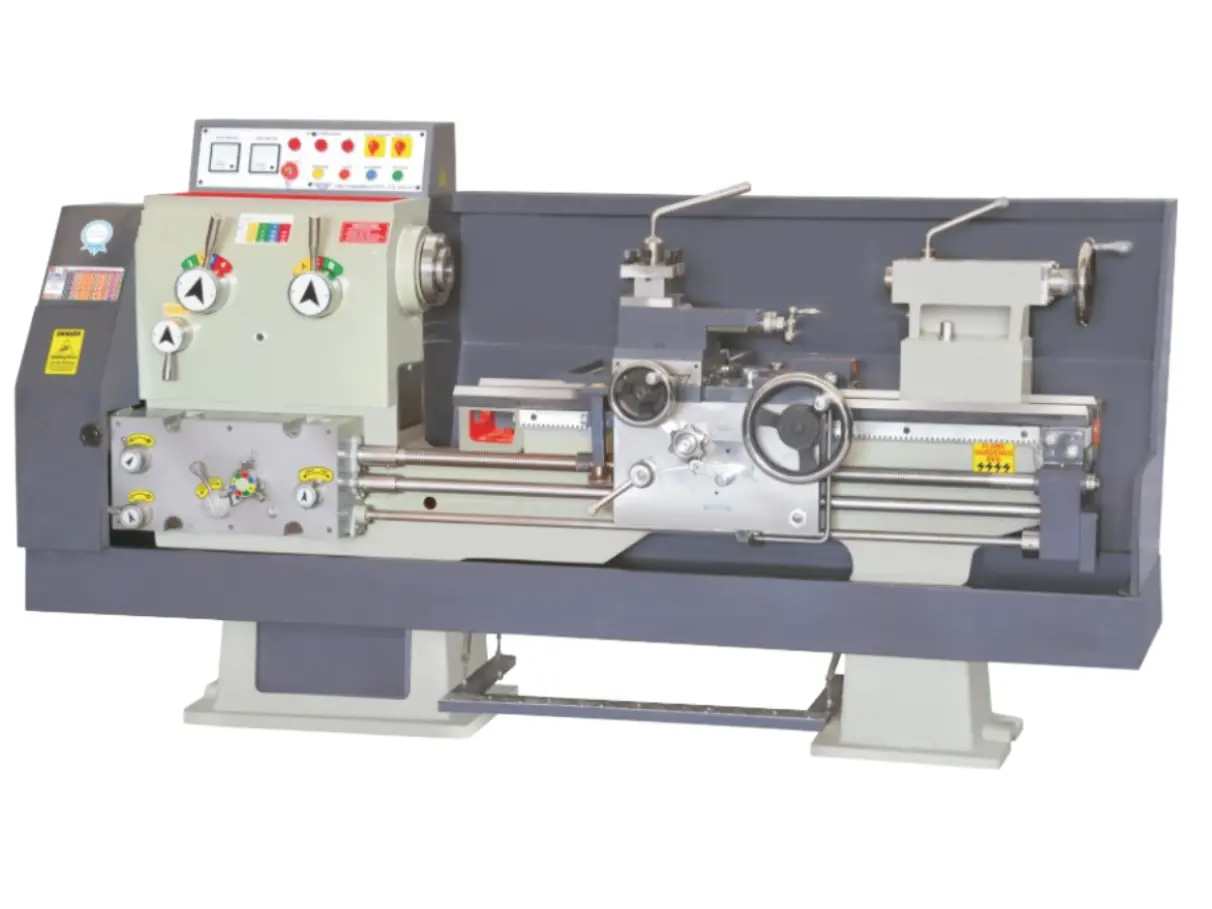
On an all geared lathe, a gearbox in the headstock does the job. You pull a lever instead of moving a belt. The gearbox delivers full torque at every speed, so the machine does not lose grip in a heavy cut at low RPM. All four of our geared models also have a Norton gearbox, which gives quick, accurate thread and feed changes.
| Geared model | Swing over bed | Centre height | Spindle bore | Speeds | Bed lengths |
|---|---|---|---|---|---|
| VGM-215 | 420 mm | 215 mm | 38 mm | 8 speeds, 40 to 1200 RPM | 6' |
| AGLM 6'3" | 495 mm | 255 mm | 65 mm | 8 speeds, 55 to 1200 RPM | 6'3" |
| VGH-267 Tech Master | 525 / 600 mm | 267 / 304 mm | 50 mm, or 79 / 104 mm | 12 speeds, 30 to 1060 RPM | 7' to 14' |
| AGLM-304 | 580 / 680 / 730 mm | 304 / 355 / 380 mm | 79 / 104 mm | 12 speeds, 30 to 1060 RPM | 7' to 14' |
Swipe the table sideways to see every column →
So which one? Our short version: choose geared if you cut hard metals, take interrupted cuts (a casting with holes or a keyed shaft), thread often, or run production. Choose belt driven if your work is general, your budget is tight, and you value simple upkeep.
It is not true that geared is always "better". A belt driven lathe has fewer parts to wear and runs very smoothly on finishing cuts. We go through the trade-off properly, including running costs, in our guide to all geared vs belt driven lathes.
How to Read a Lathe's Size: The Numbers That Matter
Here is the part most buyers skip. And here is where most wrong purchases come from.
When someone says "6 feet lathe", they mean the bed length. That is the length of the machine's bed, not the longest job it can hold. The headstock, the tailstock and the carriage all sit on that bed and take up room. On our heavy duty lathes, a 16 foot (4875 mm) bed takes a job of up to 3725 mm between centres. That is more than a metre less than the bed. On the VGH-267, beds from 7' to 14' take jobs from 1000 to 3100 mm.
So always ask for the admit between centres figure, not just the feet.
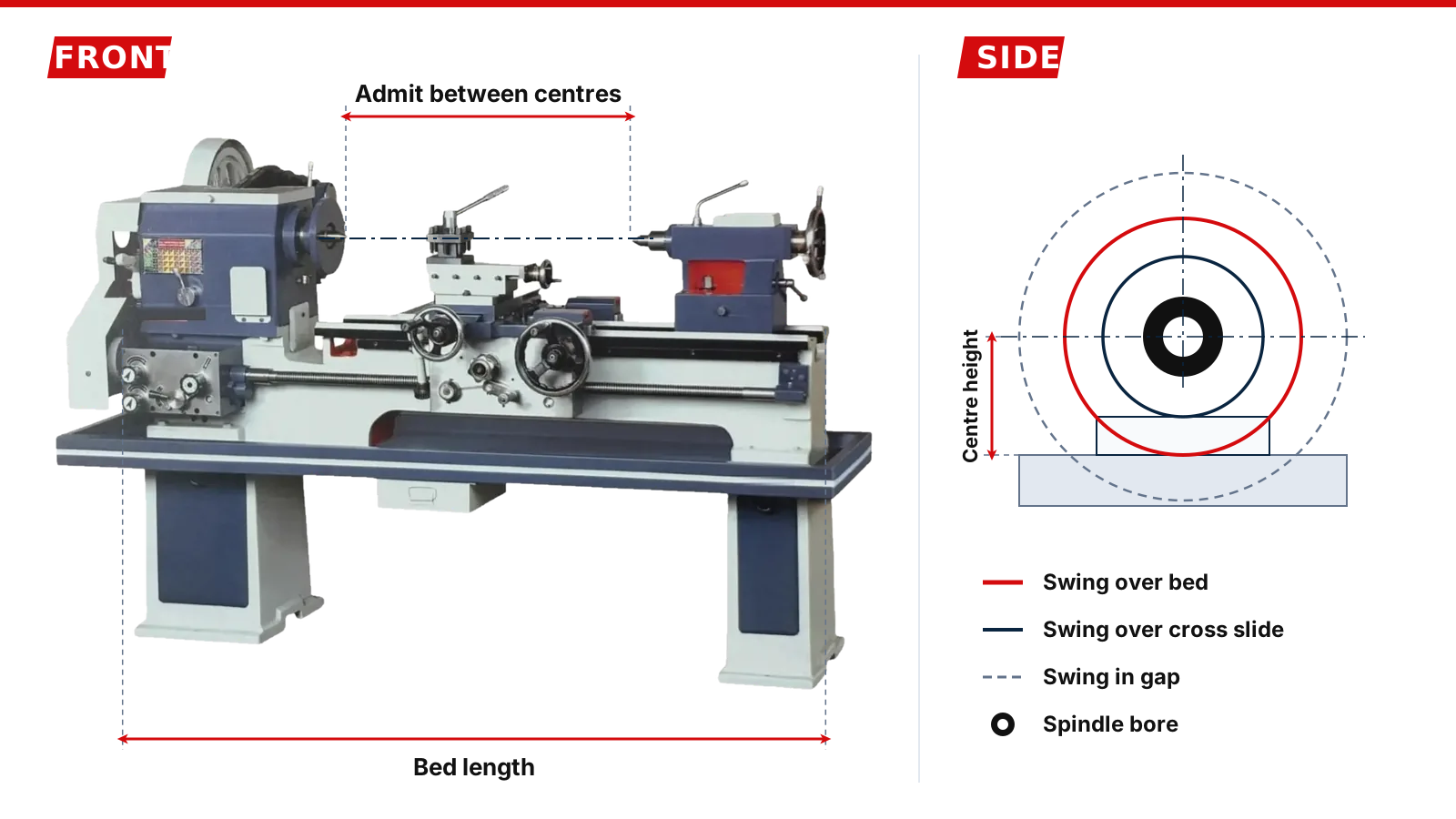
Here are the numbers that matter, in the order we check them:
1. Swing over bed
The biggest diameter that will turn without hitting the bed. On paper it is a little under twice the centre height. The VGM-215 has a 215 mm centre height and a 420 mm swing, for example.
2. Swing over cross slide
The carriage's cross slide sits higher than the bed. So for a long job that runs over the carriage, this smaller figure is your real limit. On our extra heavy duty lathe it is 545 mm against a 735 mm swing over bed. Long, fat jobs are judged by this number.
3. Swing in gap
Many lathes have a removable piece of bed near the chuck, called the gap. Take it out, and you can turn a short, wide disc or flange that would never fit over the full bed. Our medium duty lathe goes from 420 mm to 645 mm in the gap. Handy for the odd big pulley. Not something to plan daily production around.
4. Centre height
The height from the bed to the spindle's centre line. It decides the swing. Some of our geared models come in more than one centre height. The AGLM-304, for instance, comes in 304, 355 or 380 mm, so you can match the machine to your usual diameters without jumping to a different model.
5. Admit between centres
The longest job you can hold between the chuck and the tailstock centre. As we saw, it is always well short of the bed length. Pump shafts, rollers and long spindles live or die by this number.
6. Spindle bore
The hole through the spindle. If you feed bar stock through the headstock and cut pieces off, the bore is your limit on bar size. Our 8 standard configurations run from 38 mm on the VGM-215 to 125 mm on the extra heavy duty lathe, and lathes supplied to order go up to a 250 mm bore. Pipe threading work usually needs a big bore, which is why pipe shops ask about our heavy duty machines with 80 and 100 mm bores.
7. Spindle nose and speed range
The spindle nose (A2-4, A2-6 or A2-8 on our geared models) decides which chucks and faceplates fit. The speed range decides whether you can cut both small and large diameters at the right surface speed. That is the next section.
Speed and Power: A Quick Sum Worth Doing
Every material has a comfortable cutting speed, measured in metres per minute at the tool tip. The bigger the diameter, the slower the spindle has to turn to keep that surface speed.
The sum is simple:
RPM = (cutting speed in m/min x 1000) / (3.14 x diameter in mm)
Take mild steel with a high speed steel tool at roughly 30 m/min. Treat that as a ballpark; your tool maker's chart has the final word.
- A 50 mm shaft wants about 190 RPM.
- A 300 mm flange wants about 32 RPM.
Now look back at the tables. Our heavy duty, extra heavy duty, VGH-267 and AGLM-304 machines all go down to 30 or 31.3 RPM. That is exactly why they suit big work. The VGM-215 and AGLM 6'3" reach 1200 RPM at the top, which suits small diameters and finishing cuts.
Power is the other half. At low RPM on a big job, the cut needs torque. A geared head passes the motor's full torque to the spindle at every speed. A belt can slip if you push it too hard. If your work is large diameter and hard material, this is the real reason to look at geared machines and 5 HP motors.
Match the Machine to Your Work
Put it together and most jobs fall into a handful of patterns. Use this as a starting point, then talk to us with your actual drawings.
| Your work | Where to start | Why |
|---|---|---|
| Training institute, college workshop, maintenance room | Light duty lathe | 315 mm swing covers teaching jobs; simple to run and maintain |
| General job shop: shafts, bushes, pins up to about 400 mm | Medium duty lathe | The all-rounder; 2 HP, 52 mm bore, gap bed for the odd big part |
| Precision threading and fine feeds, tool room work | VGM-215 geared lathe | Norton gearbox: 24 metric and 44 inch threads, 40 feeds, up to 1200 RPM |
| Bar stock and pipe work through the spindle | AGLM 6'3" geared lathe or heavy duty with 80 / 100 mm bore | Bore size sets your bar size |
| Long shafts for pumps, motors and conveyors | Heavy duty or VGH-267 in a long bed | Up to 3725 mm between centres |
| Rolls, large castings, sugar mill and cement plant parts | Extra heavy duty or AGLM-304 | 730 to 735 mm swing, 375 mm wide bed, 5 HP; larger lathes to order beyond that |
Swipe the table sideways to see every column →
One rule we repeat to every buyer: leave 15 to 20 percent headroom above your largest regular job. Work tends to grow. And a machine that runs at its limit every day wears faster and holds size worse.
Things Buyers Forget to Budget For
The machine is only part of the purchase. These come up after the order is placed, so plan for them now.
Power supply. Our geared lathes run on 3 phase supply. Check what your shed has before you choose, and check the motor rating against your connected load.
Foundation and levelling. A lathe is only as accurate as the floor it stands on. Heavier machines need a proper foundation. Every lathe needs careful levelling after installation, or it will turn tapers you never asked for.
Space around the machine. Allow room at the tailstock end to slide the tailstock back and load long bars. Leave space for chip removal and for the operator to stand comfortably.
Accessories. A lathe arrives with its standard fittings. Most shops soon add a second chuck (3 jaw for speed, 4 jaw for odd shapes), revolving centres, a quick change tool post and a coolant tank. Browse our lathe accessories and tooling to plan this alongside the machine.
A digital readout (DRO). For job shops doing one-off and small-batch work, a DRO saves a lot of setting time. It can be fitted to our lathes; ask when you request a quote.
Delivery, installation and commissioning. These are quoted separately from the machine price, so ask for them on the same quotation.
GST and the invoice. A proper GST invoice lets a registered business claim input tax credit on the machine. Our guide to HSN codes and GST rates for workshop machinery explains what to check.
Lead time. Standard models that we hold in stock usually ship within 7 to 10 working days. Custom configurations and heavy duty machines can take 3 to 6 weeks, so order ahead of the job, not after it arrives.
What About the Price?
Lathe prices move with bed length, swing, spindle bore, the drive type and the motor. A 6 foot light duty machine and a 14 foot AGLM-304 are not in the same world, even though both are "lathes". Accessories, freight and commissioning add to the final figure too.
The fastest way to a real number is to send us your job size and material. We will quote the right model with delivery and commissioning shown separately.
New or Second-Hand?
A used lathe can look like a bargain. Sometimes it is. More often the savings disappear into worn bed ways, a tired spindle, missing parts and no one to call when it stops. If you are weighing the two, judge them on five-year cost, not the price on the day.
Your Lathe Buying Checklist
Take this list to any supplier, including us. If a seller can't answer these, keep looking.
- What is the largest diameter I turn regularly? Add 15 to 20 percent.
- What is the longest job between centres? Check "admit between centres", not bed length.
- Will long, fat jobs pass over the carriage? Check swing over cross slide.
- Do I feed bar through the spindle? What spindle bore do I need?
- What materials do I cut most? Mild steel, alloy steel, cast iron, stainless, non-ferrous?
- Do I need precise threading or fine feeds often? That points to a geared head with a Norton gearbox.
- What lowest and highest RPM do my diameters need?
- Is 3 phase power available, and is my floor ready for the machine's weight?
- Which accessories do I need from day one?
- Who handles service and spare parts, and how fast do they respond?
How We Help You Choose
We have supplied lathes to workshops across Gujarat since 1983. It has been our privilege to serve names like L&T, Anchor by Panasonic, ITT and Mazda, as well as the small and medium job shops that have grown with us. Beyond India, we export lathes and other workshop machinery to 5 countries: Sri Lanka, Bahrain, Oman, UAE and Saudi Arabia.
As an Authorized Distributor, we sell only the brands we represent officially. Every lathe comes with the manufacturer's warranty and genuine spare parts. All 8 configurations are on show at our Ahmedabad showroom, so you can see the machine, move the levers and check the finish before you decide. After installation, our service team responds within 48 hours for alignment checks, spare parts and warranty coordination.
Frequently Asked Questions
Which lathe machine is best for a small workshop?
For a general job shop, a medium duty lathe is the usual starting point. It swings 420 mm, has a 52 mm spindle bore and a 2 HP motor, and handles steel, cast iron and stainless. If you thread often or need fine feeds, a geared model like the VGM-215 is worth the extra.
What does a "6 feet lathe" mean?
It means the length of the bed is about 6 feet (1825 mm). It does not mean the machine holds a 6 foot job. The headstock, tailstock and carriage use part of the bed, so check the "admit between centres" figure for the longest job you can turn.
What is the difference between a light duty and a heavy duty lathe?
A heavy duty lathe has a wider, heavier bed, a bigger spindle bore and more motor power. It can take deeper cuts on bigger, harder jobs all day. In our range, light duty swings 315 mm with a 40 mm bore. Heavy duty swings 490 mm with up to a 100 mm bore and beds up to 16 feet.
Is an all geared lathe better than a belt driven lathe?
Not always. A geared head gives full torque at every speed and quicker, more precise threading, so it is better for hard metals, interrupted cuts and production. A belt driven lathe is simpler, smoother on light finishing cuts and cheaper to maintain. Choose by your work, not by the label.
How long does delivery take?
Standard models held in stock usually ship within 7 to 10 working days. Custom configurations and heavy duty machines can take 3 to 6 weeks. Delivery and commissioning are quoted separately.
Ready to Match a Lathe to Your Work?
Send us three things: your largest job's diameter and length, the material, and roughly how many pieces you make in a month. We will suggest the right model, send the spec sheet and quote it with delivery and commissioning.
Prefer WhatsApp? Message us on +91 70410 38728, or visit the showroom at 1/A, Ramnesh Estate, Opp. Shilp Arcade, Memco-Bapunagar Road, Ahmedabad 380025.

- Start hereLathe Machine Buying Guide: Types, Sizes and How to Choose the Right OneYou are here
- GuideAll Geared vs Belt Driven Lathe: Which One Does Your Workshop Need?
3 more guides coming in this series.