

Choose a mechanical power press for fast, repetitive cutting work: punching, blanking, piercing and notching in volume, plus deep drawing on heavy presses from 50 ton. Choose a hydraulic press for slower, controlled work: pressing, straightening, bending, bush and bearing fitting, assembly and forming, where you need full force at any point of the stroke.
In this guide 8 sections
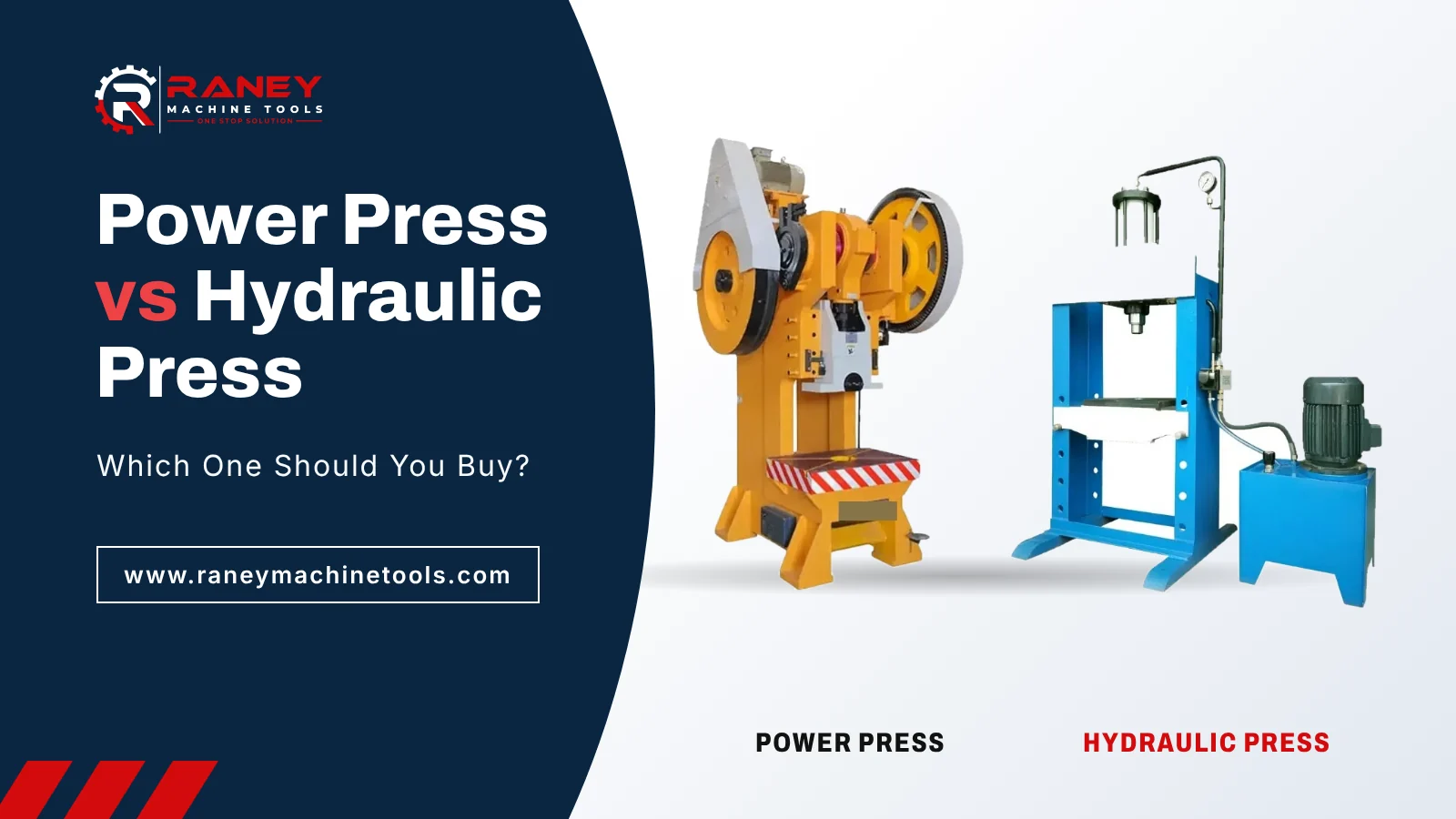
Both machines press metal. Both come in tonnages that sound similar on paper. And in Indian workshops the names get mixed up all the time; some people call every press a "power press", others use "power press" only for the mechanical kind.
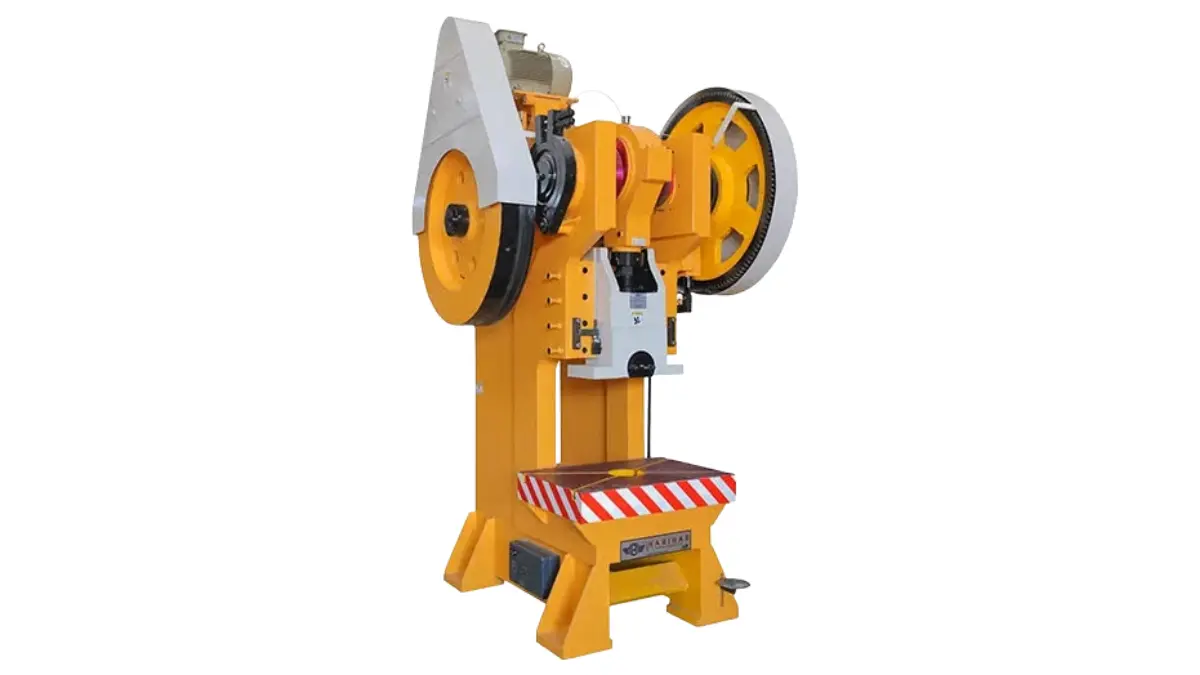
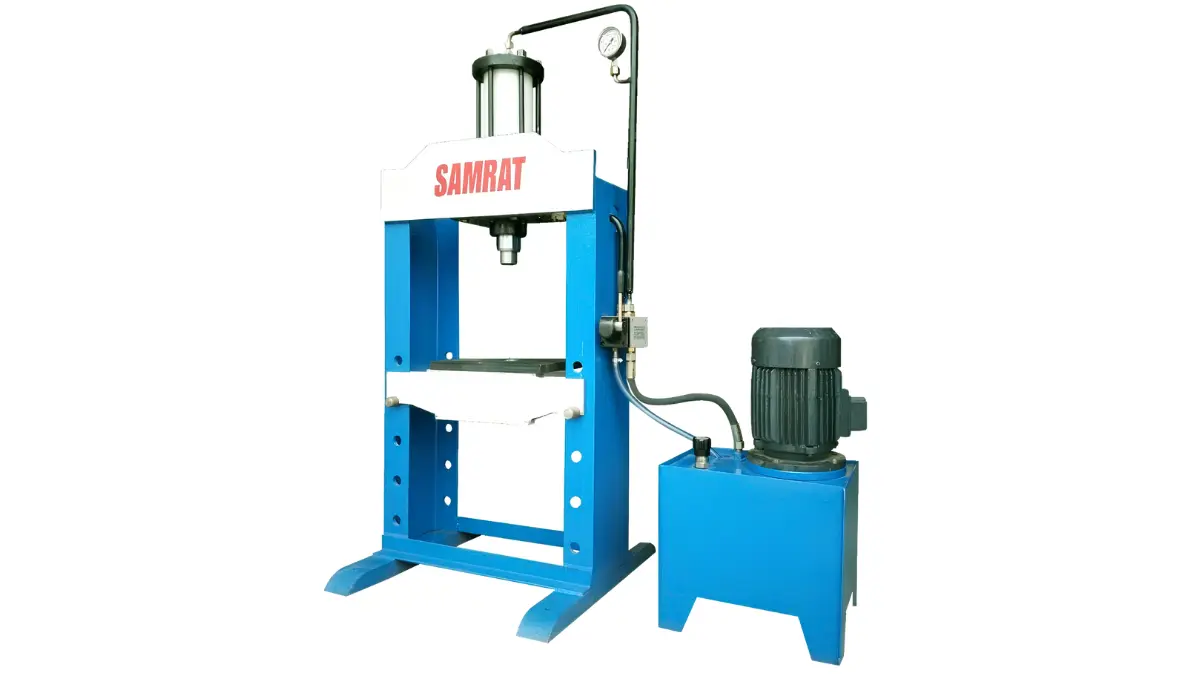
So let us be clear from the start. In this guide, a power press means a mechanical press: a motor, a flywheel and a crankshaft driving the ram. A hydraulic press means a press whose ram is pushed by oil pressure from a pump and cylinder.
They are built for different jobs. Pick the one that matches your work and it will serve you for decades. Pick the wrong one and you will fight it every day. For the basics of how a power press works and how to calculate tonnage, see our power press machine guide.
How Each One Makes Force
Mechanical power press
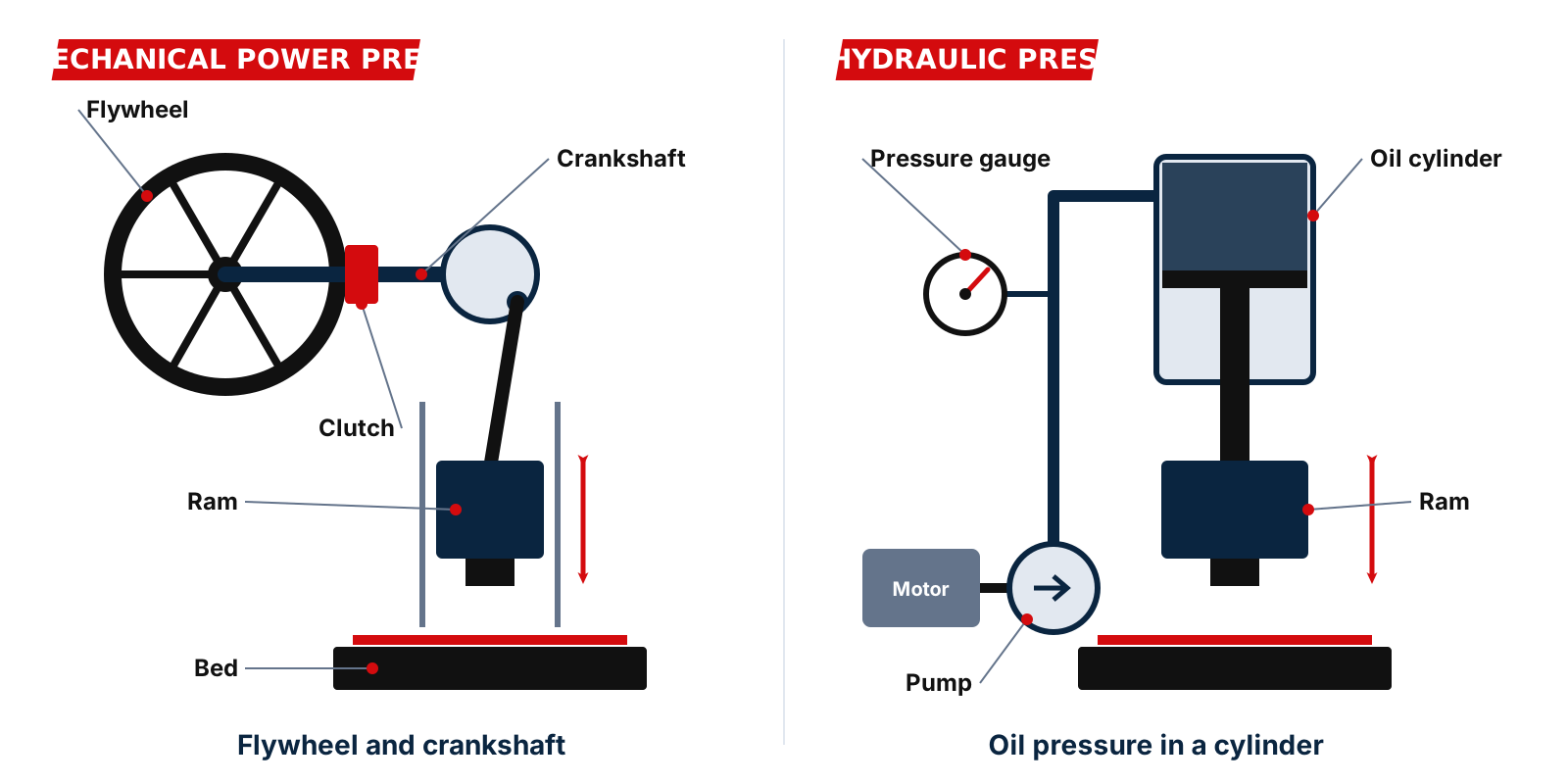
A motor keeps a heavy flywheel spinning. Engage the clutch and the flywheel's stored energy turns the crankshaft, which drives the ram through one fixed stroke. Full force is available only near the bottom of the stroke, where the crank is almost straight.
The result: speed and repeatability. Our C-frame power presses run at 30 to 82 strokes per minute depending on size. Every stroke is the same length, at the same speed, ending at the same point.
Hydraulic press
An electric motor drives a pump, the pump pushes oil into a cylinder, and the cylinder pushes the ram. The force comes from oil pressure, so full tonnage is available at any point in the stroke, and the ram can stop, hold and reverse wherever you want.
The result: control. Our hydraulic presses move the ram at about 3 to 7 mm per second, slow and steady, and come with a pressure gauge so the operator can see the force being applied.
Side by Side
| Mechanical power press | Hydraulic press | |
|---|---|---|
| How force is made | Flywheel and crankshaft | Oil pressure in a cylinder |
| Speed | Fast: 30 to 82 strokes/min in our range | Slow and controlled: 3 to 7 mm/sec in our range |
| Where full force is available | Near the bottom of the stroke | Anywhere in the stroke |
| Stroke | Fixed per set-up (adjustable during die setting) | Can stop, hold and reverse at any point |
| Overload | Can jam at bottom dead centre if overloaded | Relief valve limits the force |
| Best for | Punching, blanking, piercing, notching; heavy presses (50 to 200 T) also handle deep drawing | Pressing, straightening, bending, assembly, forming |
| Our range | 5 to 200 ton, 9 sizes | 5 to 300 ton, 11 sizes |
| Typical maintenance | Clutch, brake, flywheel bearings, lubrication | Oil, seals, filters, hoses, pump |
Swipe the table sideways to see every column →
Which One, Job by Job
| Your job | Our pick | Why |
|---|---|---|
| Punching holes in sheet, in volume | Power press | Fast, repeatable, low cost per hit |
| Blanking washers, brackets, small parts | Power press | Speed matters; the die does the work |
| Piercing and notching | Power press | Same as above |
| Straightening shafts and bent parts | Hydraulic press | Needs slow, controlled force and a gauge |
| Pressing bearings, bushes and pins in or out | Hydraulic press | Controlled push, stop when it seats |
| Bending thick plate or bar | Hydraulic press | Full force throughout a longer stroke |
| Forming parts with a long working stroke | Hydraulic press | Force is available along the whole stroke |
| Deep drawing, thick material and large blanks in volume | Heavy power press (50 to 200 T) | Our heavy presses handle these at production speed |
| Assembly and staking | Hydraulic press | Control and the ability to hold pressure |
| Sheet bending in long lengths | Neither, ideally | A press brake is the specialist machine for long bends |
Swipe the table sideways to see every column →
Speed vs Control: A Real-World Way to Think About It
Picture a shop making 10,000 small brackets a month. Each bracket needs two holes punched and its outline blanked. A mechanical press doing 40 strokes a minute finishes the job in a fraction of the time a hydraulic press would need. Speed is everything here, and the mechanical press wins easily.
Now picture a maintenance workshop that straightens bent shafts, presses bearings off pump spindles and bends the odd bracket from 12 mm plate. Each job is different, each needs care, and a shaft pushed too far is scrap. The hydraulic press, with its slow ram, pressure gauge and ability to stop exactly where you want, is the right tool.
Most growing shops eventually own both.
What About Overload?
This is a practical difference that matters on the shop floor.
If a mechanical press meets more resistance than it can deliver, for example a double blank or the wrong material, it can stall near the bottom of the stroke. Freeing a stuck press takes time and can damage the die or the machine. That is one more reason to size the tonnage with a proper margin.
A hydraulic press has a relief valve. If the job needs more force than the press is set for, the pressure simply stops rising. The operator sees it on the gauge and stops.
Running Costs and Maintenance
- Mechanical presses need regular lubrication, clutch and brake inspection, and attention to the flywheel bearings. The motor is small for the tonnage because the flywheel stores the energy, so power consumption is modest.
- Hydraulic presses need clean oil at the right level, filters, and attention to seals and hoses. A leaking seal is a mess and a fire risk if ignored. Larger hydraulic presses also have larger motors: 2 HP on our 5 ton model, up to 20 HP on the 300 ton.
Our hydraulic presses come with two V-blocks, a pressure gauge, a bed up-down handle, two bed resting rods and an L.N. key as standard. From 60 ton upward, two job movement rollers are included. Options include an electric control panel, a two-speed power pack, a heat exchanger and a pressure holding system.
Safety on Both
Both presses can cause serious injuries, and mechanical presses are especially unforgiving because the ram completes its stroke once the clutch engages. Every power press we supply has a safety clutch. Guards, two-hand controls and light curtains can be fitted on both types to suit your factory and the law.
Frequently Asked Questions
What is the difference between a power press and a hydraulic press?
A power press uses a motor, flywheel and crankshaft to drive the ram through a fast, fixed stroke, which suits punching and blanking. A hydraulic press uses oil pressure to move the ram slowly with full force anywhere in the stroke, which suits pressing, straightening, bending and assembly.
Which is faster, a power press or a hydraulic press?
A mechanical power press is much faster. Our power presses run at 30 to 82 strokes per minute. Our hydraulic presses move the ram at about 3 to 7 mm per second.
Can a hydraulic press be used for punching?
It can, but it is slow for volume work. For repetitive punching and blanking, a mechanical power press gives far higher output per shift.
Which press is better for bending?
For bending thick plate and bar, a hydraulic press is the better choice because force is controlled through the stroke. For long sheet bends, a press brake is the specialist machine.
Is "power press" the same as "mechanical press"?
In most technical usage, yes. In this guide, "power press" means a mechanical press with a flywheel and crankshaft. Some sellers use the term loosely, so always confirm which type is being quoted.
Still Deciding?
Tell us the jobs you need to do: the operation, the material and thickness, and the output you need. We will tell you honestly which press fits, or whether you need both.
See the full specifications on our power and hydraulic presses page: the 9 power press models and the 11 hydraulic press models.

- Start herePower Press Machine Guide: Types, Tonnage and Choosing One for Sheet Metal Work
- GuidePower Press vs Hydraulic Press: Which One Should You Buy?You are here
2 more guides coming in this series.