

For punching and blanking, tonnage = cut length (mm) x sheet thickness (mm) x shear strength (N/mm²), divided by 9,810. Add a margin of 20 to 30 percent. Then check the stroke, the bed size and the shut height against your die, and the strokes per minute against your output target.
In this guide 11 sections
- How a Mechanical Power Press Works
- C-Frame Presses: Why Most Workshops Use Them
- How to Calculate Power Press Tonnage
- The Other Numbers That Matter
- Power Press or Hydraulic Press?
- Floor, Foundation and Power
- Safety Is Not Optional
- Beyond the Press: Other Forming Machines
- Our Power Press Checklist
- How We Help
- FAQs
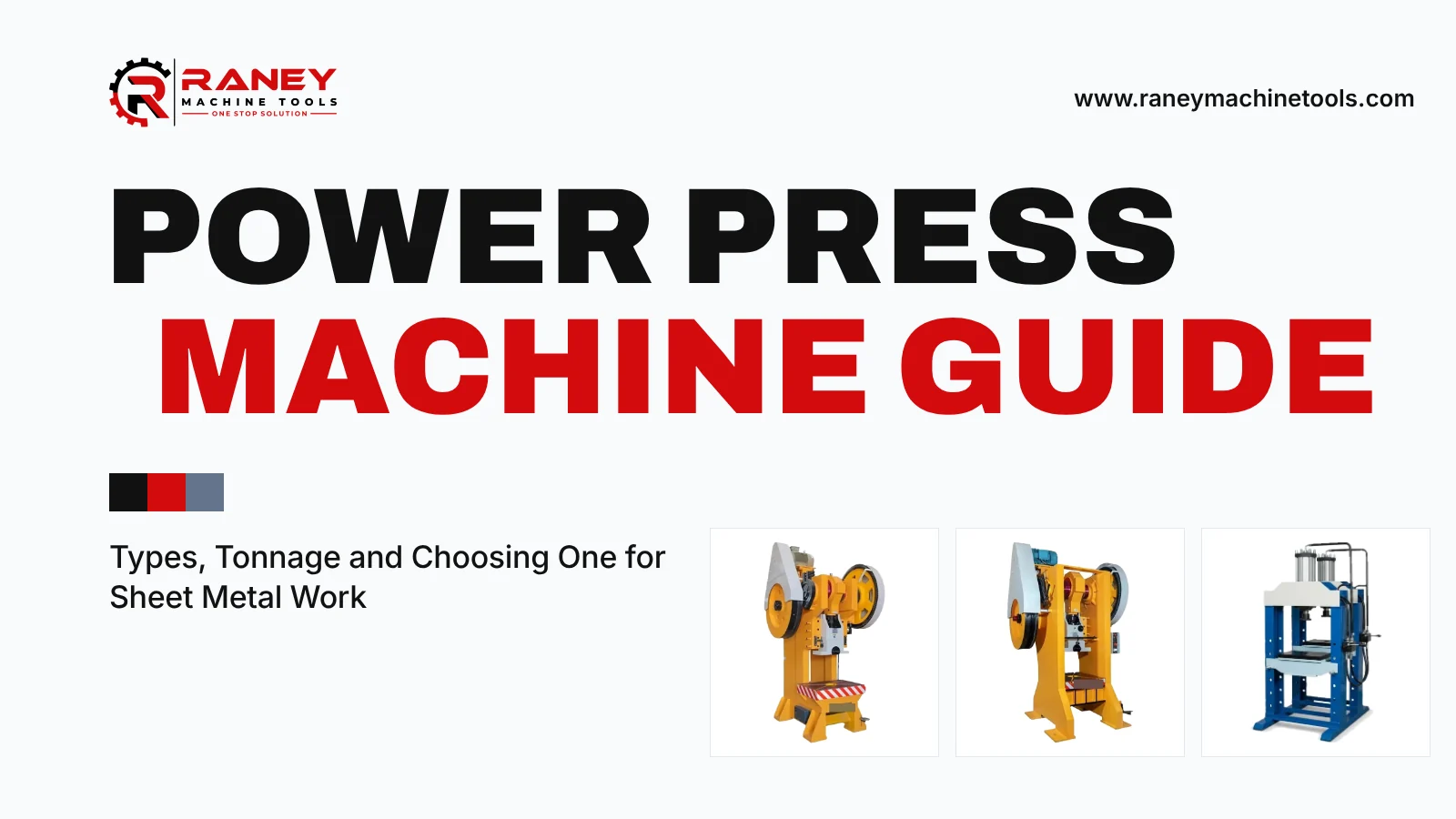
A power press is one of the hardest-working machines in any sheet metal shop. It can punch, blank, bend and form thousands of parts a day, and it will do it for decades if it is chosen and looked after properly.
Choose it badly and you live with the consequences. Too little tonnage, and the press stalls or the frame strains. Too much, and you have paid for iron you will never use, in a machine that runs slower than it needs to. A stroke too short for your die, a bed too small for your tooling: these mistakes are expensive to correct after the press is bolted down.
This guide covers how a power press works, how to calculate the tonnage you need, and what else to check before you buy. If you are weighing a mechanical press against a hydraulic one, our comparison of power press vs hydraulic press goes into that decision in detail.
How a Mechanical Power Press Works
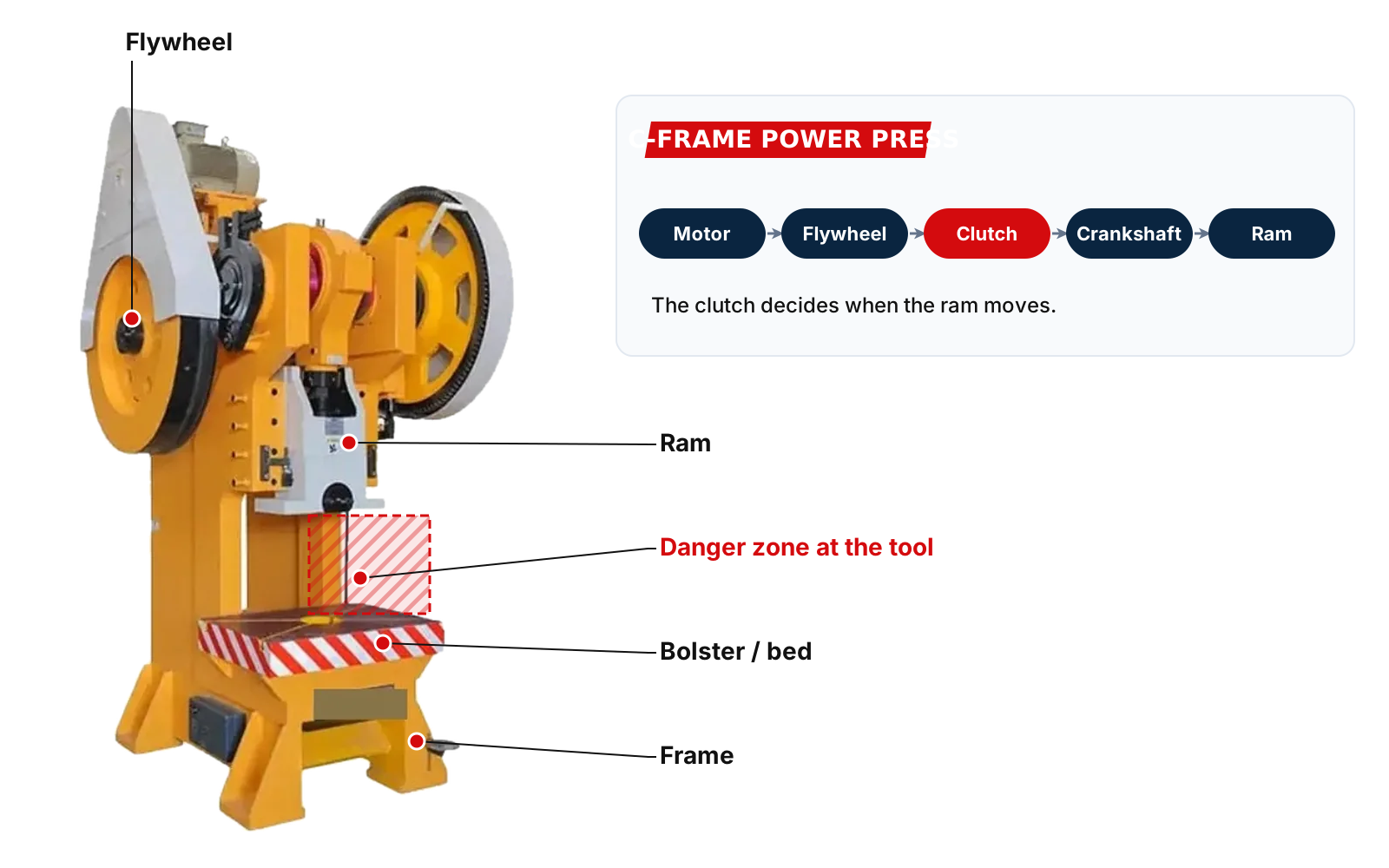
A motor spins a heavy flywheel. When the operator trips the clutch, the flywheel's stored energy turns a crankshaft, and the crank drives the ram down and back up in one fixed stroke. The die is fixed to the bed, the punch to the ram, and the sheet between them is cut or formed.
The flywheel is the clever part. The motor doesn't have to produce the full force of the cut itself; it only has to keep the flywheel spinning. The cut takes a fraction of a second of stored energy, and the motor tops the flywheel up before the next stroke. That is why a 5 ton press can run on a 0.5 HP motor.
The clutch decides when the ram moves. On every press we supply, a safety clutch controls engagement and disengagement of the ram. Guarding and controls on top of the clutch are a separate subject, and an important one; we cover it in detail in our power press safety guide.
C-Frame Presses: Why Most Workshops Use Them
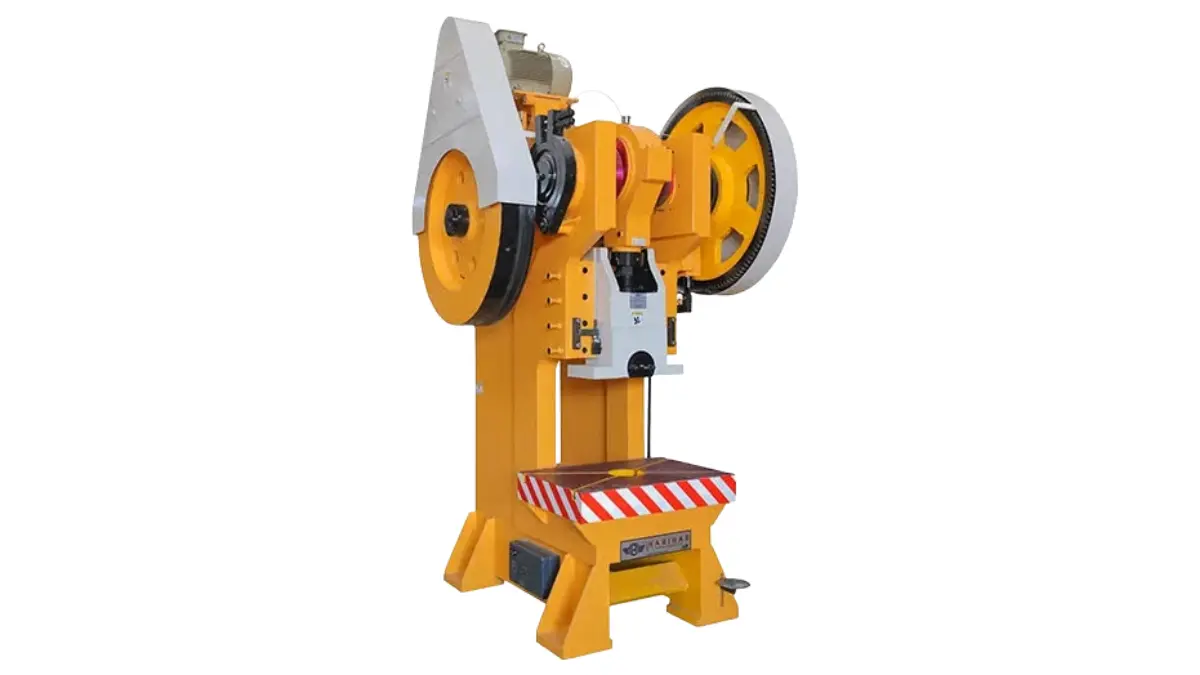
The C-frame (or gap frame) press is shaped like the letter C. The open front and sides give easy access to the die from three directions. That makes loading, unloading and die setting simple, and it is why C-frame presses are the standard choice for most small and medium sheet metal work.
The trade-off is that under heavy load, a C-frame opens very slightly at the mouth. For most punching and blanking work this is no issue. For very high tonnage or very precise progressive dies, straight-side presses are used, but those are a different class of machine.
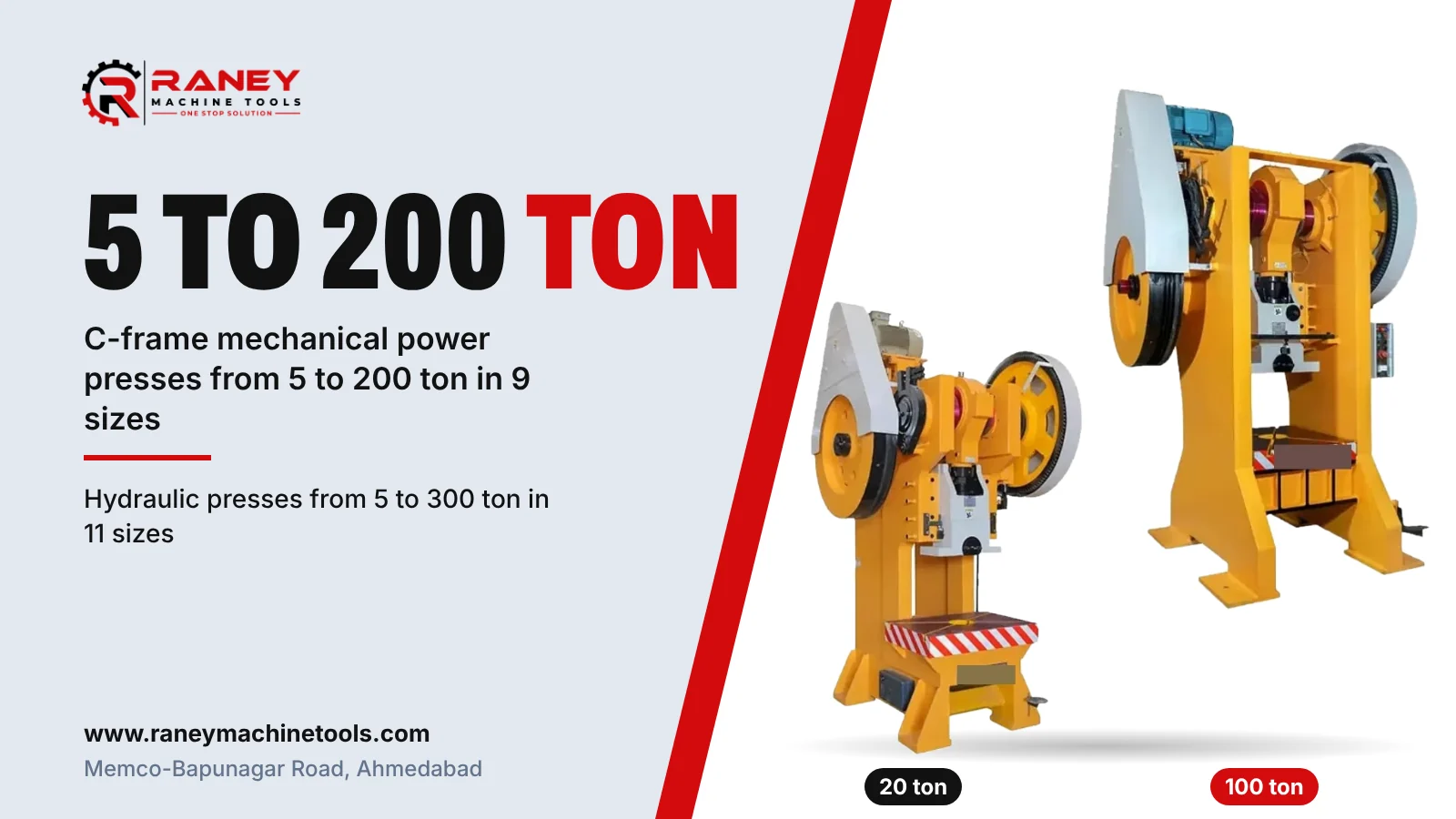
Our power press range covers 9 C-frame tonnages from 5 to 200 ton:
| Tonnage | Strokes per minute | Stroke adjustment | Bed to ram | Motor | Approx. weight |
|---|---|---|---|---|---|
| 5 T | 82 | 5 to 38 mm | 160 mm | 0.5 HP | 300 kg |
| 10 T | 72 | 5 to 51 mm | 235 mm | 1 HP | 540 kg |
| 20 T | 50 | 10 to 75 mm | 300 mm | 2 HP | 1,000 kg |
| 30 T | 40 | 10 to 75 mm | 325 mm | 3 HP | 1,400 kg |
| 50 T | 33 | 12 to 100 mm | 375 mm | 5 HP | 2,385 kg |
| 80 T | 30 | 12 to 112 mm | 450 mm | 8 HP | 3,800 kg |
| 100 T | 30 | 12 to 125 mm | 475 mm | 10 HP | 5,000 kg |
| 150 T | 30 | 12 to 140 mm | 475 mm | 15 HP | 5,800 kg |
| 200 T | 30 | 12 to 152 mm | 500 mm | 20 HP | 8,000 kg |
Swipe the table sideways to see every column →
Notice how speed falls as tonnage rises. A 5 T press makes 82 strokes a minute; from 80 T upward it is 30. Bigger presses have heavier rams and longer strokes, so they cycle slower. Don't buy a 100 T press for work a 30 T press can do; you would lose a quarter of your output for no reason.
How to Calculate Power Press Tonnage
For cutting operations (punching, blanking, piercing, notching), the force needed is the force to shear the metal along the cut line:
Force (N) = cut length (mm) x thickness (mm) x shear strength (N/mm²)
Tonnage = Force ÷ 9,810
The cut length is the full perimeter of the shape being cut. For a round hole, that is 3.14 x diameter. For a rectangle, it is twice the length plus twice the width. If the die cuts several holes in one stroke, add all the perimeters together.
A worked example
Say you want to punch a 50 mm round hole in 3 mm mild steel.
- Cut length = 3.14 x 50 = 157 mm
- Shear strength of mild steel: take about 350 N/mm² (check your supplier's figure; it varies with grade)
- Force = 157 x 3 x 350 = 164,850 N
- Tonnage = 164,850 ÷ 9,810 = about 16.8 ton
- Add a 20 to 30 percent margin for blunt tooling, harder batches and stripping: about 20 to 22 ton
So a 20 ton press would be working at its limit. A 30 ton press gives you comfortable headroom, and in our range it still runs at 40 strokes a minute.
| Material | Typical shear strength (approx.) |
|---|---|
| Aluminium (soft) | 70 to 150 N/mm² |
| Brass | 250 to 350 N/mm² |
| Mild steel | 300 to 400 N/mm² |
| Stainless steel | 450 to 550 N/mm² |
Swipe the table sideways to see every column →
These are rough working values. Use the figure for your actual material grade and temper when the job is critical.
What about bending and forming?
Bending and forming forces depend on the die opening, the bend length and the material, and the calculation is different from shearing. Many shops use a hydraulic press or a press brake for this work rather than a mechanical press, because the force and speed can be controlled through the stroke. Share your part drawing and we will help you size it. Deep drawing is different: our heavy duty power presses (50 to 200 ton) handle thick materials, large blanks and deep drawing.
The Other Numbers That Matter
Tonnage is the headline, but four other specs decide whether a press actually suits your work.
Stroke length
The distance the ram travels. It must be long enough to open the die fully, let the part out and let the operator load the next blank. Too long, and every stroke wastes time. Our presses have adjustable stroke, set during die set-up: from 5 to 38 mm on the 5 T up to 12 to 152 mm on the 200 T.
Shut height (bed to ram distance)
The space between the bed and the ram. Your die's closed height must fit inside it, with adjustment to spare. Ask your die maker for the shut height before you choose the press, not after.
Bed size
The bed must carry your die with room for clamping. Bed sizes in our range grow from 340 x 200 mm on the 5 T to 1,000 x 700 mm on the 200 T.
Strokes per minute
Your output ceiling. If you need 2,000 parts per shift from a single-hit die, and a stroke takes about 1.5 seconds at 40 strokes a minute, you know roughly where you stand once loading time is added. Check the speed before you over-buy tonnage.
Power Press or Hydraulic Press?
Both press metal. They do it very differently.
A mechanical power press uses a flywheel and crank, so it is fast and repeats the same stroke every time. It is the natural choice for punching, blanking and piercing in volume.
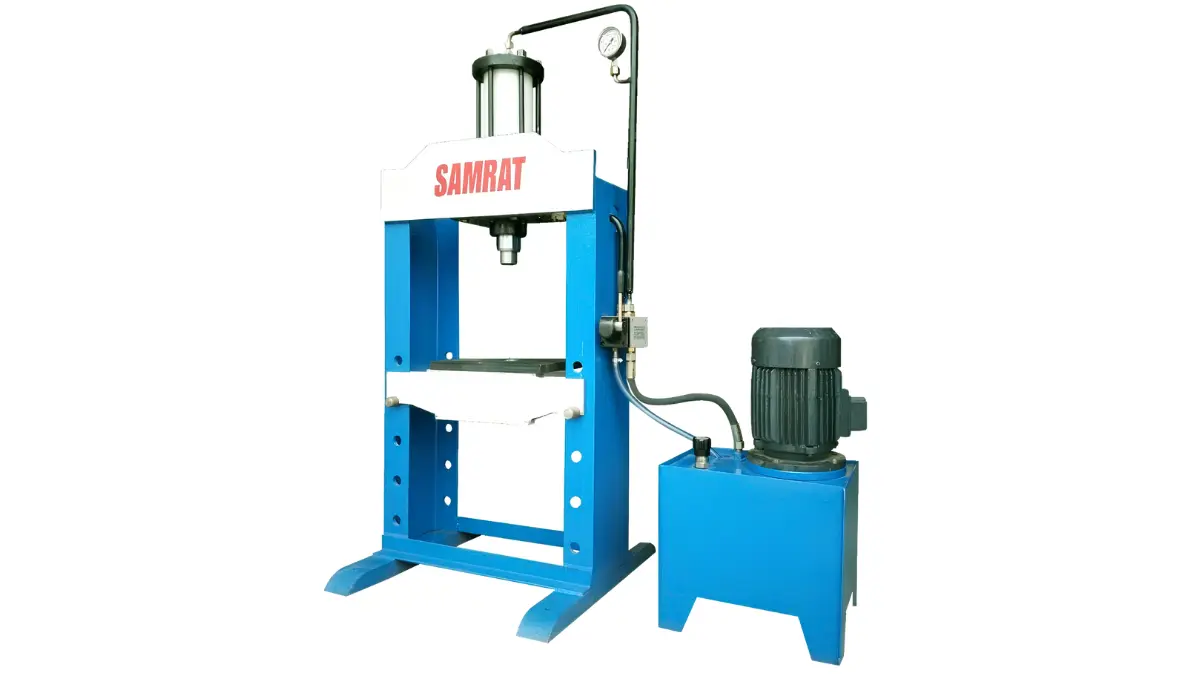
A hydraulic press moves the ram with oil pressure at a controlled speed, around 3 to 7 mm per second on our range, and can hold full force anywhere in the stroke. It suits pressing, straightening, bending, assembly and forming work. Our hydraulic presses run from 5 to 300 ton.
We compare the two in depth, with a job-by-job verdict, in power press vs hydraulic press: which one should you buy.
Floor, Foundation and Power
A press hits hard, and that energy goes into the floor.
- Weight. Our presses weigh from about 300 kg (5 T) to 8,000 kg (200 T).
- Foundation. A small press needs only a level, solid floor. Heavier presses need a reinforced concrete foundation designed for the press weight and the dynamic load of every stroke. We can provide foundation drawings and layout suggestions with your quotation.
- Power. Motors range from 0.5 HP to 20 HP. Check your connected load before ordering a larger press.
- Space. Leave room around the press for die changes, material flow and a safe operator position.
Safety Is Not Optional
Power presses are behind a large share of serious hand injuries in Indian factories. The Safe in India Foundation, which works with injured workers in the auto parts industry, reports that more than half of the injuries it has recorded happened on power presses. Every press we supply has a safety clutch, and guards, two-hand controls and light curtains can be fitted to suit your factory and local rules. Discuss safety at the quotation stage, not after the first near miss.
Beyond the Press: Other Forming Machines
Presses are not the only way to form metal. If you make bolts, studs or threaded rods, cold-forming the thread on a thread rolling machine is faster and gives a stronger thread than cutting it. See our hydraulic thread rolling machines.
If you are setting up a new sheet metal or fabrication shop, our fabrication workshop equipment list shows where a press fits alongside cutting, welding, drilling and compressed air.
Our Power Press Checklist
Before you request a quote, write down:
- The operations: punching, blanking, piercing, bending, forming
- The material and its thickness
- The largest cut length in a single stroke (or the part drawing)
- Your die's shut height and footprint
- The output you need per shift
- Your power supply and floor conditions
- The safety devices your factory needs
How We Help
We have supplied presses and workshop machinery across Gujarat since 1983, to names like L&T, Anchor by Panasonic, ITT and Mazda, and to many small sheet metal shops. We also export to 5 countries: Sri Lanka, Bahrain, Oman, UAE and Saudi Arabia. As an Authorized Distributor, we supply genuine machines with the manufacturer's warranty and spares, and our team responds within 48 hours for service.
Frequently Asked Questions
How do I calculate the tonnage of a power press?
For punching and blanking, multiply the cut length (mm) by the sheet thickness (mm) and the material's shear strength (N/mm²), then divide by 9,810 to get tons. Add 20 to 30 percent margin. A 50 mm hole in 3 mm mild steel needs about 17 ton, so a 30 ton press is a comfortable choice.
What is a C-frame power press?
It is a press whose frame is shaped like the letter C, leaving the front and sides open. That gives easy access for loading parts and setting dies, which is why it is the most common type in small and medium sheet metal shops.
How many strokes per minute does a power press make?
It depends on the size. In our range, the 5 ton press runs at 82 strokes per minute, the 10 ton at 72, the 20 ton at 50, the 30 ton at 40 and the 50 to 200 ton presses at 30 to 33.
Does a power press need a foundation?
Small presses need only a level, solid floor. Larger presses need a reinforced concrete foundation designed for their weight and dynamic loads. We provide foundation drawings with the quotation.
What tonnage range does Raney supply?
C-frame mechanical power presses from 5 to 200 ton in 9 sizes, and hydraulic presses from 5 to 300 ton in 11 sizes.
Size Your Press With Us
Send us your part drawing or the material, thickness and largest cut length, plus your die's shut height. We will work out the tonnage, suggest the right press and send the spec sheet.
See the full specifications for every model on our power and hydraulic presses page, including the hydraulic press range.

- Start herePower Press Machine Guide: Types, Tonnage and Choosing One for Sheet Metal WorkYou are here
- GuidePower Press vs Hydraulic Press: Which One Should You Buy?
2 more guides coming in this series.