

Buy a pillar drill for small and medium parts that you can move under the spindle, especially for repeat work. Buy a radial drill for large, heavy parts and for holes far from the edge, like bolt circles on big flanges. Many growing shops end up with both.
In this guide 9 sections
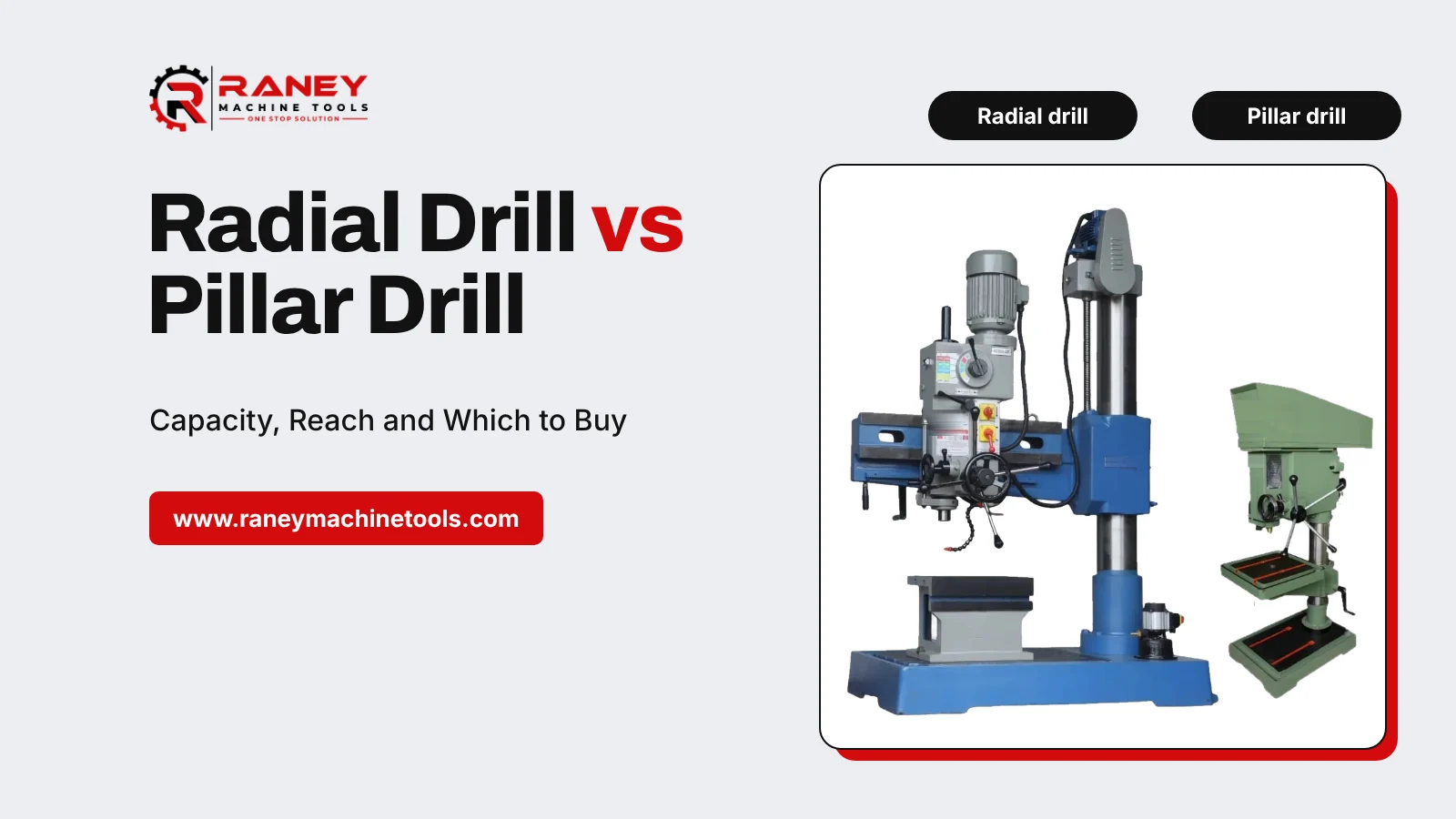
On a pillar drill, you take the job to the drill. On a radial drill, you take the drill to the job.
That one sentence explains most of the difference between the two machines, and most of the decision. If your jobs are small enough to slide around a table, a pillar drill is quick, accurate and affordable. If they are big, heavy flanges, plates and fabrications that take two people or a crane to move, a radial drill saves hours every week.
This guide compares the two on the points that matter: capacity, reach, table, speed, floor space and cost. For where drilling fits among the other machine shop machines, see our guide to lathe vs milling vs drilling vs grinding.
How a Pillar Drill Works
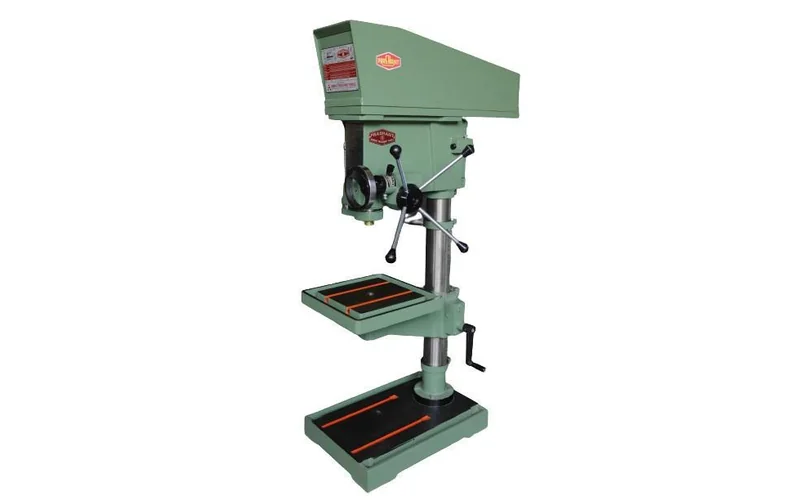
A pillar drill has a fixed round or square column. The drill head sits on top, the spindle feeds straight down, and the job is clamped on a table below. To drill the next hole, you move the job.
Pillar drills are rigid, simple and accurate, with good "feel" through the hand feed. For small drills especially, an operator can sense how the cut is going.
Our pillar drills cover:
| Model | Capacity in steel | Spindle taper | Speeds | Spindle to column | Table | Motor |
|---|---|---|---|---|---|---|
| 20 mm (bench SBR, floor SFR, floor SPR) | 20 mm | MT-2 | 8, 86 to 3,360 RPM | 203 mm | 275 x 275 mm | 1 HP, 3 phase |
| 25 mm heavy duty | 25 mm | MT-3 (MT-4 optional) | 8, 96 to 3,200 RPM | 267 mm | 342 x 342 mm | 1 HP, 3 phase |
| 25 mm with 15" centre | 25 mm MS / 32 mm CI | MT-4 | 8, 96 to 3,200 RPM | 381 mm | 465 mm | 1.5 / 2 HP, 3 phase |
| 40 mm heavy duty | 40 mm | MT-4 | 8, 45 to 1,350 RPM | 320 mm | 460 x 460 mm | 1.5 HP, 3 phase |
Swipe the table sideways to see every column →
We also supply a 20 mm drilling cum tapping machine, the 20 mm drill with tapping added, so you can drill and thread a hole on the same machine (tapping up to 12 mm in cast iron and 6 to 8 mm in mild steel and stainless steel).
How a Radial Drill Works
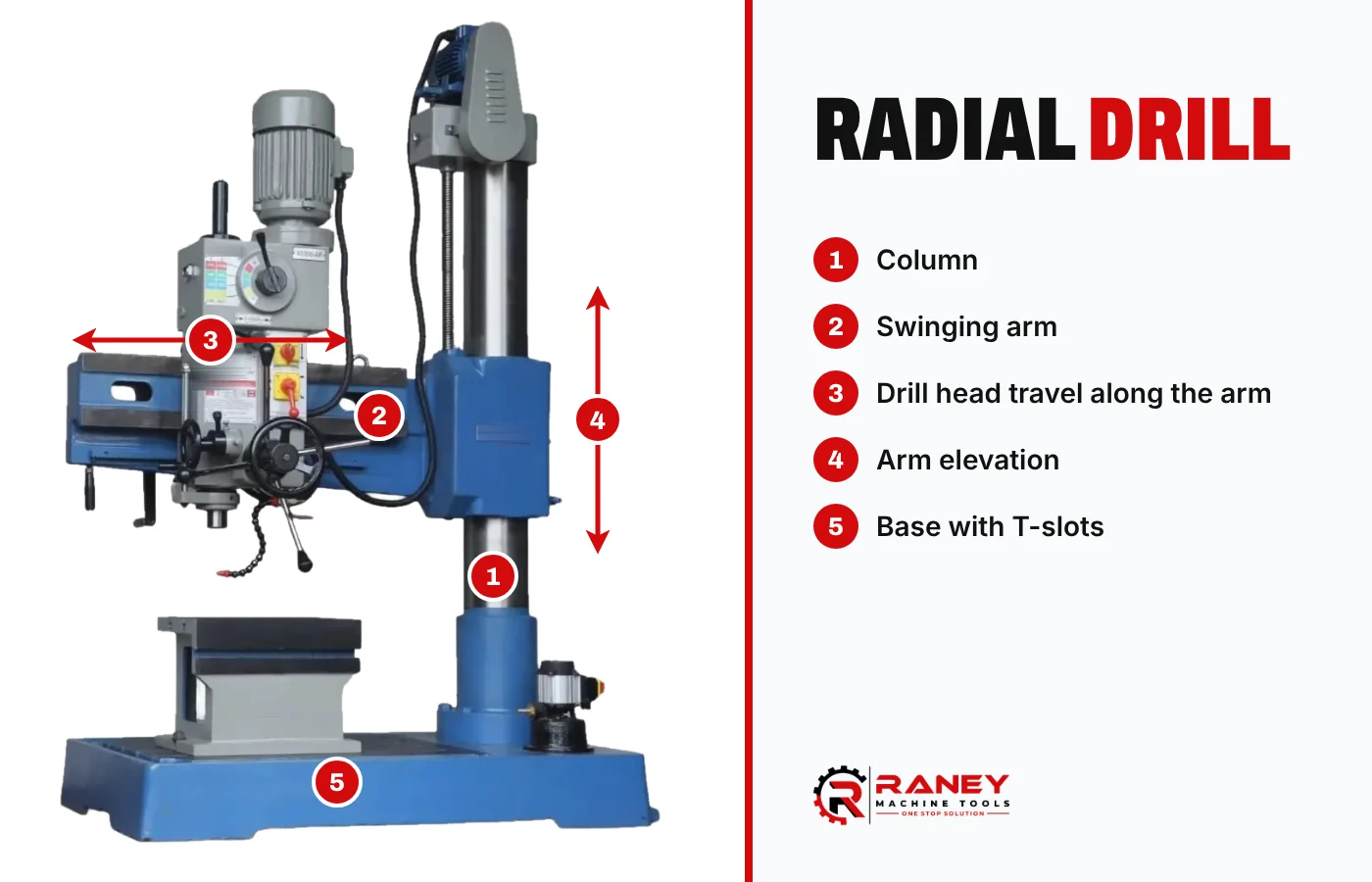
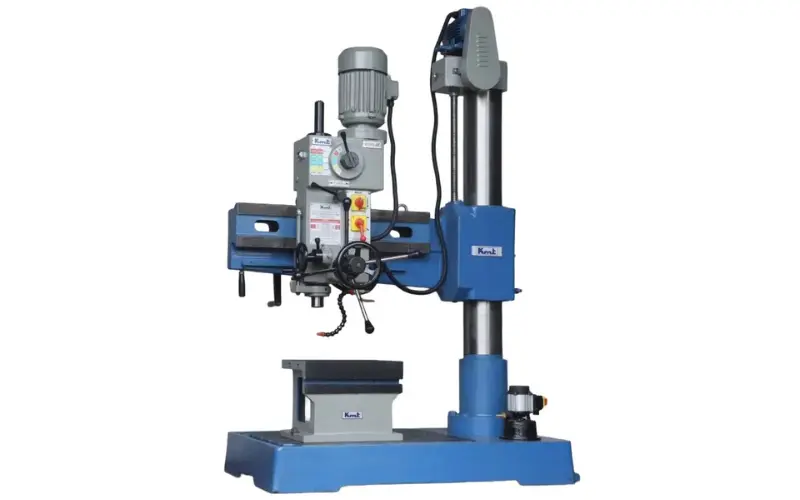
A radial drill has a heavy column with an arm that swings around it. The drill head slides in and out along the arm, and the arm can be raised and lowered by its own motor. Together, these movements let you put the spindle almost anywhere over a big base or a large job, without moving the job at all.
Our radial drills:
| Model | Drilling capacity | Reach (column to spindle) | Drilling radius | Speeds | Motors |
|---|---|---|---|---|---|
| 40/900-AF, all geared | 38 mm MS / 40 mm CI; boring 50 mm; tapping 20 mm MS / 22 mm CI | 335 to 900 mm | 980 mm | 50 to 1,750 RPM | 2.5 HP head + 0.5 HP arm elevation |
| Universal SER-1 / SER-2, V-belt | 38 mm MS and CI | 360 to 810 mm | 440 to 895 mm | 8, 62 to 1,980 RPM | 1.5 HP + 0.5 HP arm elevation |
Swipe the table sideways to see every column →
The universal radial comes in two versions: SER-1 with hand fine feed, and SER-2 with auto power feed. Its arm swivels 90 degrees each way.
Side by Side
| Pillar drill | Radial drill | |
|---|---|---|
| What moves | The job | The drill head |
| Best for | Small and medium parts | Large, heavy parts and fabrications |
| Reach from column | 203 to 381 mm in our range | Up to 900 mm in our range |
| Capacity in steel | 20 to 40 mm | 38 mm (MS) |
| Feel on small drills | Very good | Less sensitive |
| Floor space | Small; bench models fit on a workbench | Large; needs a dedicated area |
| Set-up time on big jobs | Slow; job must be moved for each hole | Fast; clamp once, drill everywhere |
| Price | Lower | Higher |
Swipe the table sideways to see every column →
Three Questions That Decide It
1. How big and heavy are your jobs?
This is the main one. If two people can lift your typical job and slide it under the spindle, a pillar drill works. If you need a crane or a forklift, every hole on a pillar drill means unclamping, lifting and re-clamping. On a radial drill you clamp once and swing the head to each hole.
2. How far are the holes from the edge?
A pillar drill can only reach as far as its spindle-to-column distance: 203 mm on our 20 mm model, up to 381 mm on the 25 mm model with 15" centre. A hole in the middle of a 1 metre plate is out of reach. A radial drill's head travels along the arm, reaching up to 900 mm from the column on the 40/900-AF.
3. What size holes, in what material?
Capacity ratings are for mild steel unless stated otherwise. Cast iron drills more easily, so the cast iron figure is often higher (32 mm on our 25 mm with 15" centre, 40 mm on the 40/900-AF). Harder steels reduce the effective capacity. Don't buy a machine that will run at its limit every day.
Capacity: A Common Mistake
"40 mm capacity" doesn't mean a drill likes making 40 mm holes all day. It means it can do it in mild steel when needed. For holes that big, many shops drill a pilot hole first and open it up in a second step, which is easier on the machine and the drill.
If most of your holes are 10 to 16 mm, a 20 or 25 mm machine is plenty. If you regularly drill 25 to 32 mm holes in steel, step up to the 40 mm pillar drill or a radial.
Speed Matters Too
Small drills need high RPM; big drills need low RPM and plenty of torque. Look at the speed range against your hole sizes:
- Our 20 mm and 25 mm pillar drills reach 3,200 to 3,360 RPM at the top, ideal for small drills.
- The 40 mm pillar drill starts at 45 RPM, for big drills in steel.
- The 40/900-AF radial runs 50 to 1,750 RPM through a geared head, so it holds torque at low speed for large holes and boring.
Which One, by Type of Shop
| Your shop | Our usual suggestion |
|---|---|
| Small job shop, light engineering, mostly holes under 16 mm | 20 mm pillar drill |
| Drilling and tapping lots of small holes | 20 mm drilling cum tapping |
| General workshop, medium parts, production drilling | 25 mm heavy duty pillar drill |
| Larger parts that still fit under a pillar drill | 25 mm with 15" centre |
| Heavy fabrication, big holes in steel, parts that still fit a table | 40 mm heavy duty pillar drill |
| Large flanges, plates and fabrications | Universal radial drill (SER-1 / SER-2) |
| Heavy work, boring and tapping large holes | All geared radial drill 40/900-AF |
Swipe the table sideways to see every column →
All our drill machines run on 3 phase power. Single phase models are not available for this industrial range.
Don't Forget the Tooling
Our drills use Morse taper spindles: MT-2 on the 20 mm models, MT-3 or MT-4 on the 25 mm models and MT-4 on the 40 mm and radial machines. That means standard drill chucks, sleeves and taper-shank drills fit. A good drill vice and the right sleeves make a cheap machine fast, and a fast machine faster. See our accessories and tooling.
Frequently Asked Questions
What is the difference between a pillar drill and a radial drill?
On a pillar drill the spindle is fixed and you move the job under it. On a radial drill the drill head moves along a swinging arm, so you can drill anywhere on a large job without moving it. Pillar drills suit small and medium parts; radial drills suit large, heavy parts.
Which drill is better for large flanges?
A radial drill. Its swinging arm and sliding head reach every hole in a bolt circle without moving the flange. Our all geared 40/900-AF reaches up to 900 mm from the column with a 980 mm drilling radius.
What drilling capacity do I need?
Match it to the largest hole you drill regularly, with some margin. A 20 mm machine handles most light engineering. 25 to 32 mm covers medium-duty production. 40 mm is for heavy fabrication and big holes in steel.
Why is the cast iron capacity higher than mild steel?
Cast iron is more brittle and breaks into small chips, so it drills more easily than tougher mild steel. That is why many drills are rated for a larger hole in cast iron.
Can I tap on a pillar drill?
Yes, with a tapping attachment, or choose our drilling cum tapping machine, which drills and taps on the same machine.
Find the Right Drill for Your Work
Tell us your typical job size, the hole sizes and the material. We will suggest the right drill and send the spec sheet.
See every model in detail on our drill machines page.

- Start hereLathe vs Milling vs Drilling vs Grinding: Which Machine Does Which Job?
- GuideRadial Drill vs Pillar Drill: Capacity, Reach and Which to BuyYou are here
3 more guides coming in this series.