

The lathe spins the job to make round things. The drilling machine makes holes. The milling machine spins the cutter to make flats, slots, steps and profiles. Shaping and slotting machines cut flats, grooves and keyways with a single-point tool. The grinder finishes surfaces to tight size and smooth finish. The balancing machine makes rotating parts run without vibration.
In this guide 11 sections
- The One Idea That Separates Them
- The Lathe: For Anything Round
- The Drilling Machine: For Holes
- The Milling Machine: For Flats, Slots and Shapes
- Shaping and Slotting: Simple Tools, Real Value
- The Grinding Machine: For Size and Finish
- The Balancing Machine: For Anything That Spins Fast
- Job to Machine: A Quick Reference
- Which Machine Should a New Shop Buy First?
- How We Help
- FAQs
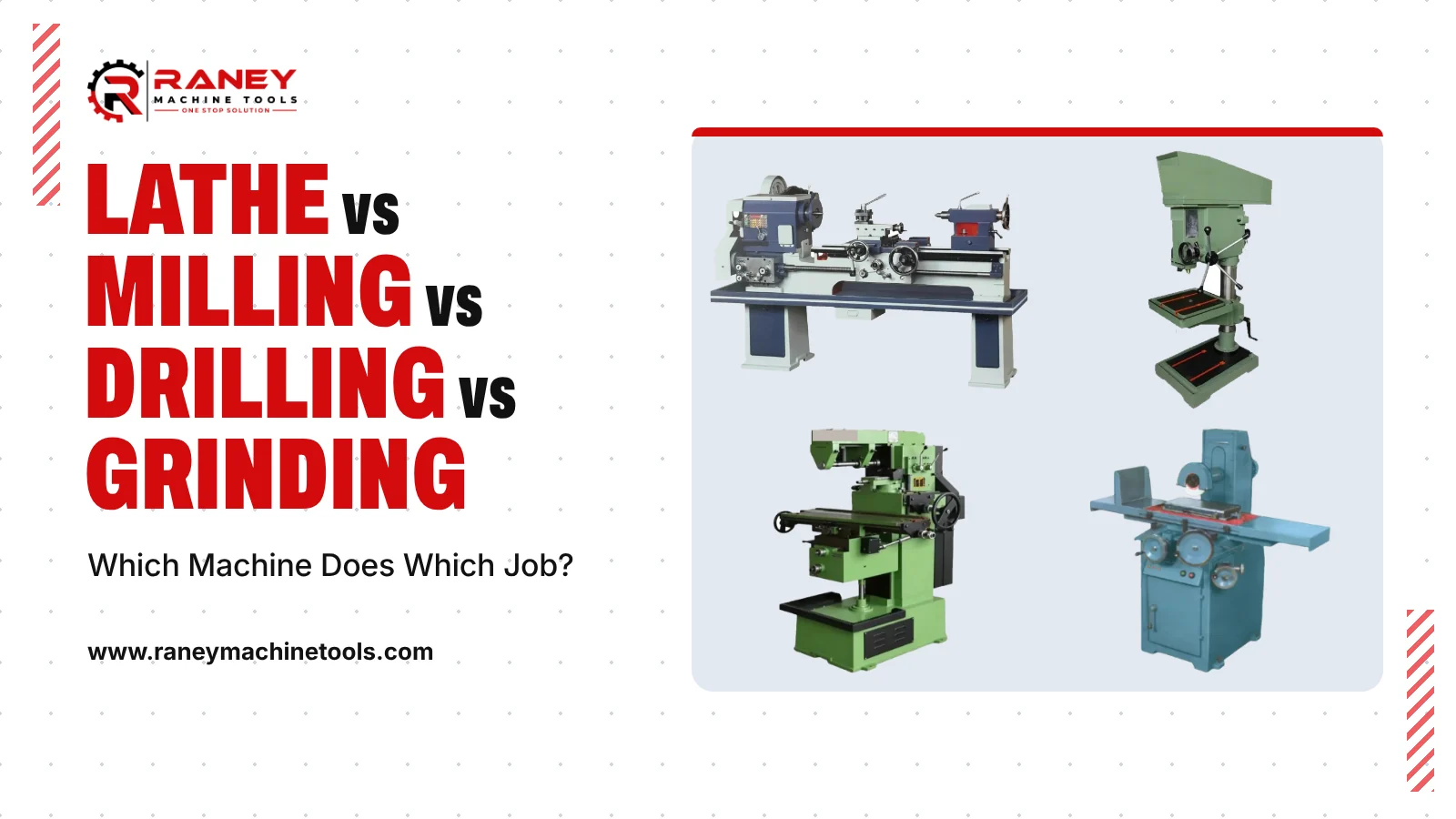
A machine shop is a team. The lathe, the drill, the milling machine and the grinder each have a position they play best, and a good shop puts the right machine on the right job.
Get it wrong and you feel it in your costs. We have seen shops cutting keyways slowly on a lathe because they didn't have a keyway machine, and others drilling big flanges on a small pillar drill because nobody had priced a radial. Neither is a disaster. Both are money left on the table every single day.
This guide explains what each machine does, where one stops and the next one starts, and how to decide what your shop needs next. Each section links to a deeper guide when you are ready to choose a specific machine.
The One Idea That Separates Them
Every one of these machines removes metal with a cutting edge or an abrasive. What separates them is simple: what moves, and how.
| Machine | What spins or moves | What it makes best |
|---|---|---|
| Lathe | The job spins; the tool moves along and across it | Round parts: shafts, pins, bushes, threads, bores |
| Drilling machine | The drill spins and feeds down into a fixed job | Holes, plus tapping, reaming and counter-boring |
| Milling machine | The cutter spins; the job moves on the table | Flats, slots, steps, pockets, gears, profiles |
| Shaping machine | A single-point tool strokes back and forth across the job | Flat surfaces, grooves, shoulders, external keyways |
| Slotting machine | A single-point tool strokes up and down | Internal keyways, splines and slots in bores |
| Grinding machine | An abrasive wheel spins at high speed | Precise size and fine finish on flat or round surfaces |
| Balancing machine | The finished rotor spins on sensors | Measures and corrects unbalance in rotating parts |
Swipe the table sideways to see every column →
The Lathe: For Anything Round
If the finished part is round, it probably starts on a lathe. Turning outside diameters, facing ends, boring holes on the centre line, cutting threads and parting off: the lathe does all of it.
What it can't do well is anything that isn't round or isn't on the centre line: flat faces on the side of a part, slots, holes off-centre, pockets. That is where the other machines come in.
Choosing a lathe is a big decision on its own. Our lathe machine buying guide covers duty classes, sizes and how to match one to your work.
The Drilling Machine: For Holes
You can drill on a lathe, but only on the centre line of a spinning job. Most holes in real parts are somewhere else: bolt circles on flanges, holes through plates, tapped holes in brackets. A drilling machine holds the job still and brings the drill to it.
Two main types cover most workshops:
- Pillar drills have a fixed column. You move the job under the spindle. Fast and accurate for small and medium parts.
- Radial drills have an arm that swings and a drill head that slides along it, so you move the drill to the job. Built for big, heavy parts you don't want to keep shifting.
Our range covers pillar drills from 20 to 40 mm capacity in steel, radial drills up to 38 mm in mild steel, and a drilling cum tapping machine that drills and threads on the same machine. See our drill machines, and our comparison of radial drill vs pillar drill to decide between them.
The Milling Machine: For Flats, Slots and Shapes
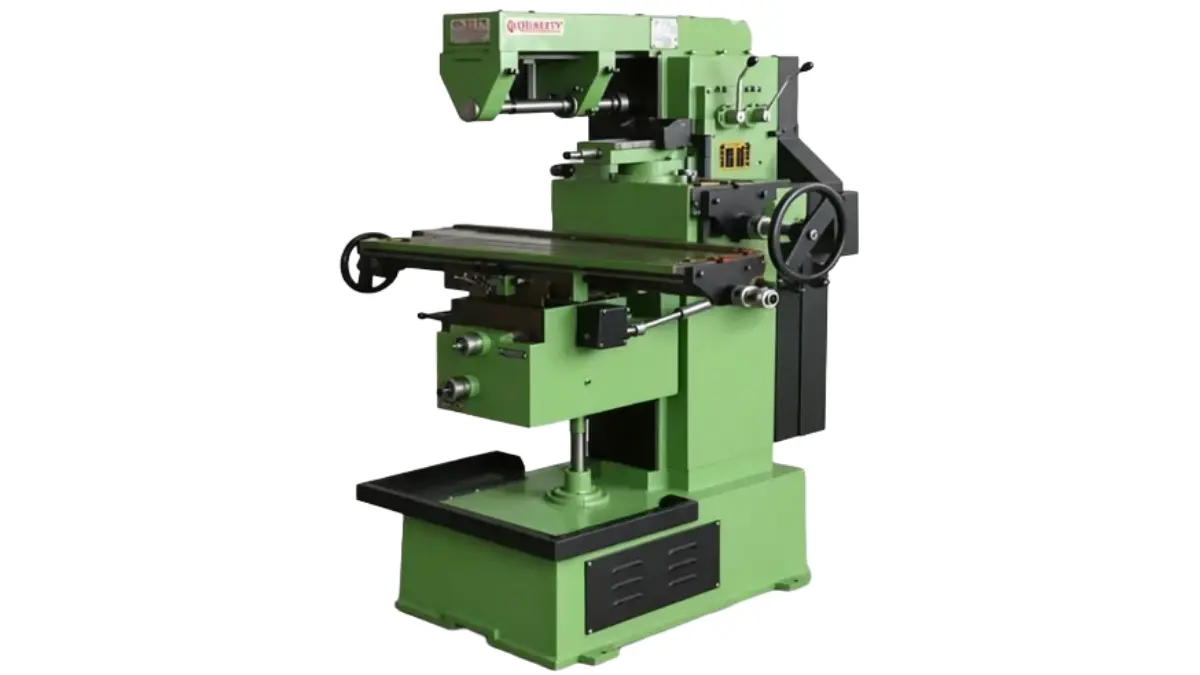
On a milling machine the cutter spins and the job moves on a table, in three directions. That makes it the most versatile machine in the shop for anything that isn't round: flat faces, steps, slots, pockets, angles, gear teeth with a dividing head, and precise holes off the centre line.
- Universal milling machines have a horizontal spindle and a table that can swivel, which suits slab milling, slot cutting and gear cutting. Ours come in 6 sizes, with table lengths from 762 to 1,474 mm.
- Vertical turret milling machines have a vertical head that tilts and swivels, great for face milling, drilling, boring and die work. Ours have 16 speeds from 70 to 4,620 RPM.
Shaping and Slotting: Simple Tools, Real Value
Shaping and slotting machines cut with a single-point tool that moves back and forth in a straight line.
- A shaping machine strokes horizontally across the job: flat surfaces, grooves, shoulders and external keyways. Our range runs from 12" to 40" stroke.
- A slotting machine strokes vertically, which lets it reach inside a bore to cut internal keyways, splines and slots that are hard to make any other way. Ours run from 178 to 305 mm stroke.
They are slower than milling for production, but the tooling is cheap and the set-up is quick. For one-off jobs and repair work, that often makes them the faster option overall.
Keyway milling machines are specialists: they cut keyways on shafts quickly and to P9 tolerance, with semi-automatic and PLC-controlled automatic models.
Browse all six types on our milling and shaping machines page.
The Grinding Machine: For Size and Finish
Cutting tools leave marks and can only hold size so closely. A grinding wheel, with thousands of tiny abrasive grains, removes very small amounts of material at a time. That gives a fine finish and tight dimensional control, and it works on hardened steel that cutting tools struggle with.
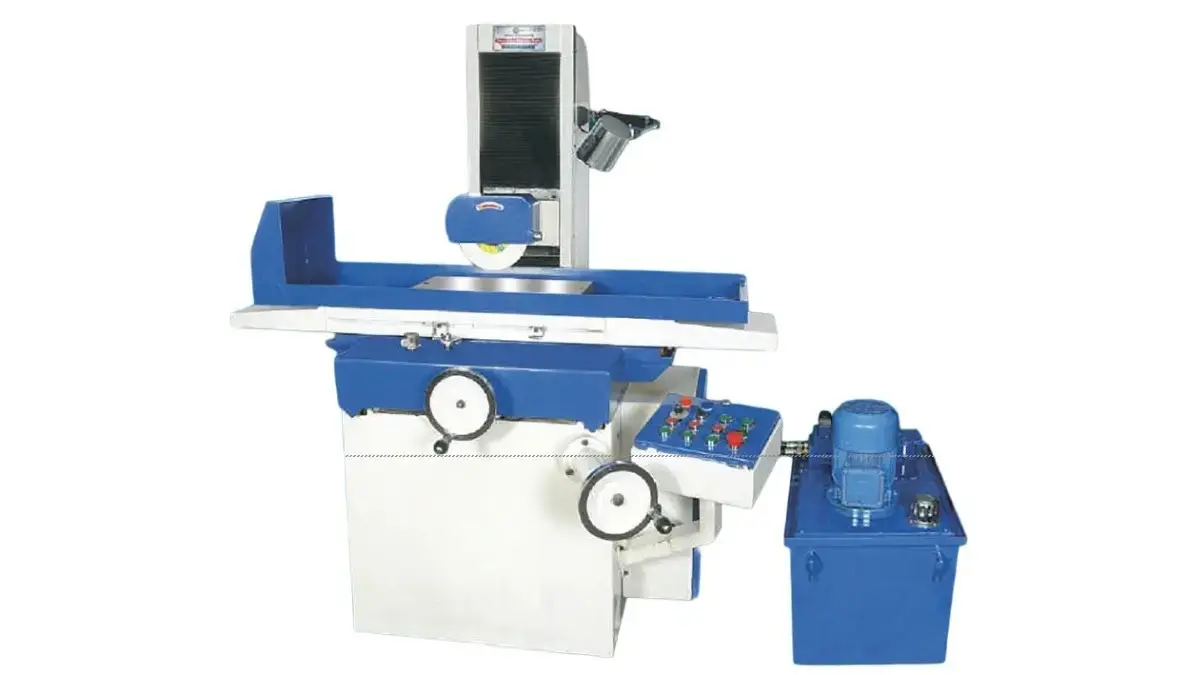
- Surface grinders finish flat surfaces. Our range covers manual (mechanical), fully automatic servo drive and hydraulic machines, with tables from 175 x 350 mm to 500 x 1,000 mm.
- Cylindrical grinders finish round surfaces: shafts, pins, spindles and rollers. Ours handle grinding lengths from 300 to 1,500 mm.
Grinding usually comes last, after a part has been turned or milled and often after heat treatment. See our grinding machines.
The Balancing Machine: For Anything That Spins Fast
A rotor can be machined perfectly and still shake. If its mass is not evenly spread around its axis, it vibrates, and the faster it spins, the worse it gets. A dynamic balancing machine spins the part, measures how much unbalance there is and where, and shows you where to add or remove material.
Fans, impellers, motor armatures, pump rotors, pulleys and flywheels all benefit. Our range covers vertical machines for disc-type parts and horizontal machines for shaft-type rotors up to 10,000 kg. See our balancing machines.
Job to Machine: A Quick Reference
| The job | First choice | Also possible |
|---|---|---|
| Turn a shaft to diameter | Lathe | Cylindrical grinder for final size |
| Cut an external thread | Lathe | Thread rolling machine, for volume |
| Drill a bolt circle on a flange | Radial drill | Milling machine with a dividing head |
| Drill and tap holes in brackets | Pillar drill or drilling cum tapping | Radial drill |
| Mill a flat face or step | Milling machine | Shaping machine, for one-offs |
| Cut a keyway on a shaft | Keyway milling machine | Milling machine, shaping machine |
| Cut a keyway inside a pulley bore | Slotting machine | Keyway attachment on a lathe |
| Cut gear teeth | Milling machine with dividing head | Specialist gear cutting machines |
| Finish a flat surface to tight tolerance | Surface grinder | Milling, for less demanding work |
| Finish a hardened pin to size | Cylindrical grinder | Tool post grinder on a lathe |
| Stop a fan or impeller vibrating | Balancing machine |
Swipe the table sideways to see every column →
Which Machine Should a New Shop Buy First?
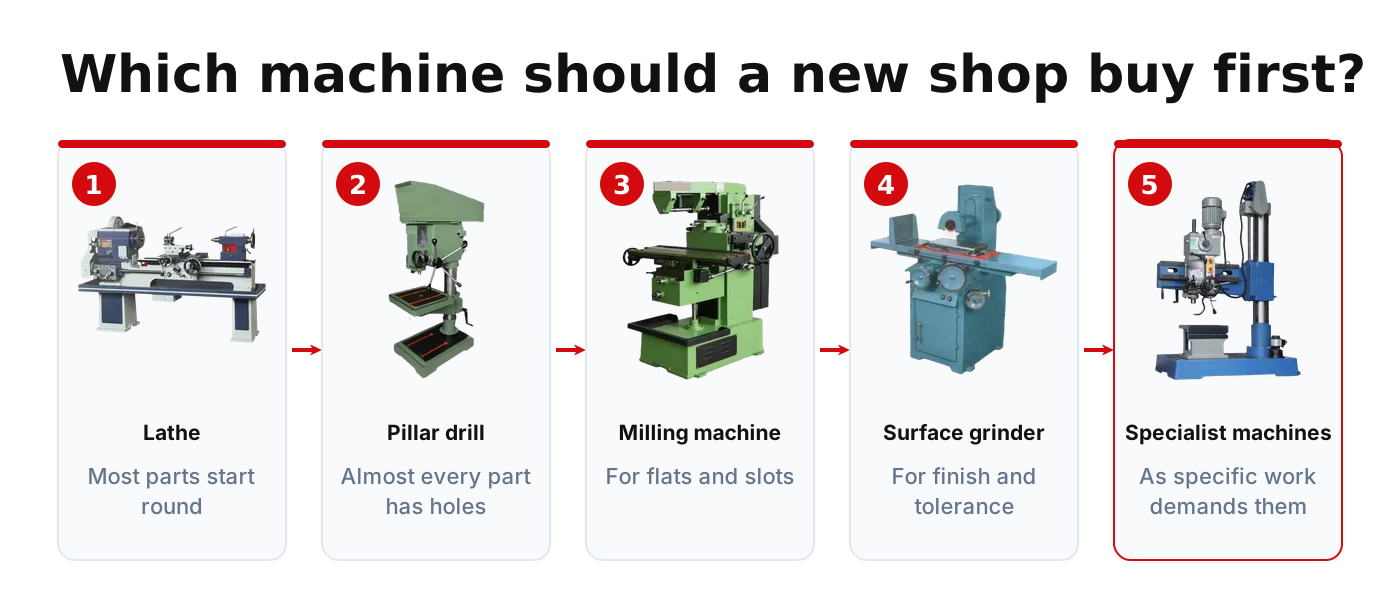
It depends on your work, but most general machine shops grow in roughly this order:
- Lathe, because most parts start round
- Pillar drill, because almost every part has holes
- Milling machine (or a shaping machine on a tight budget), for flats and slots
- Surface grinder, once customers start asking for finish and tolerance
- Radial drill, slotting or keyway machine, cylindrical grinder, as specific work demands them
If you also do fabrication (cutting, welding, presses and compressed air), see our fabrication workshop equipment list.
How We Help
We have supplied lathes, drills, milling, shaping, grinding and balancing machines to workshops across Gujarat since 1983, including L&T, Anchor by Panasonic, ITT and Mazda. Our export customers in Sri Lanka, Bahrain, Oman, UAE and Saudi Arabia receive the same documentation and support. As an Authorized Distributor, every machine comes with the manufacturer's warranty and genuine spares, and our team responds within 48 hours for service. Visit our Ahmedabad showroom to see the machines side by side.
Frequently Asked Questions
What is the difference between a lathe and a milling machine?
On a lathe, the job spins and the tool stays still, so it makes round parts. On a milling machine, the cutter spins and the job moves on the table, so it makes flats, slots, steps and other non-round shapes.
What is the difference between a drilling machine and a milling machine?
A drilling machine feeds a spinning drill straight down to make holes. A milling machine uses cutters that cut on their sides as well as their ends, and moves the job in three directions, so it can make flats, slots and profiles as well as holes.
Can a lathe do the work of a milling machine?
Only in a limited way, with special attachments. A lathe is built for round work. For regular flat, slot or pocket work, a milling machine is much faster and more accurate.
Why is grinding done after machining?
Grinding removes very small amounts of material to reach tight size and a fine finish, and it works on hardened steel. Parts are usually turned or milled close to size first, often heat treated, then ground to final size.
What machines are needed for a small machine shop?
Most start with a lathe and a pillar drill, then add a milling or shaping machine, and later a surface grinder. The exact list depends on the parts you make.
Plan Your Next Machine With Us
Tell us what you make and which jobs are slowing you down. We will suggest the machine that will make the biggest difference, and send you the spec sheet.
Or browse our full range of workshop machinery.

- Start hereLathe vs Milling vs Drilling vs Grinding: Which Machine Does Which Job?You are here
- GuideRadial Drill vs Pillar Drill: Capacity, Reach and Which to Buy
3 more guides coming in this series.